domingo, 17 de enero de 2016

Hello, Computer: Just what was that computer Star Trek's Gene Roddenberry used?

We solve the mystery of who made the generic-looking computer that Star Trek's Gene Roddenberry used for years.


5096 0
Was Gene Roddenberry a Mac guy or a PC guy? How about neither?


His vision of the future inspired legions of engineers, nerds, and techies, as well as Bluetooth headsets, the iPad, Siri, and cell phones.
But what kind of techie was the late Star Trek creator Gene Roddenberry in real life? Or more specifically, what kind of computer did the man use?
These questions all bubbled up when Gene Roddenberry’s long-lost floppy disks surfaced. The disks, all artifacts in themselves, were salvaged, but information about the actual computer he used to create them has been a mystery.
Roddenberry had two of these generic-looking machines. One his estate kept after he died, while the other was sold off in an auction to benefit charity in 2010. For that, auction house Julien’s Live described it as “IBM identification number ‘GS 113302’ dual floppy disk drives with built-in monitor and separate keyboard. This early portable IBM PC retailed for nearly $3,000 in the early 1980s. The metal case has a “GR” handwritten on upper left side, indicating that this computer was owned and used by Gene Roddenberry.”
The auctioned computer appears to have been purchased by a fan, where its notoriety has secured it a spot on the Star Trek convention circuit.
trekmovie
Gene Roddenberry’s computer is important enough that it even made the Star Trek convention circuit in 2014.

That’s no IBM

If you know your computers, you know that’s not an IBM PC. In fact, it’s so generic, you’d think it was one of those plastic props used in an Ikea furniture store to sell Blërg desks.
I consulted our resident vintage computing expert Benj Edwards of Vintagecomputing.com and our own "This Old Tech" column, and even he was stumped by the make of Roddenberry’s computer.
“That’s probably not an IBM compatible machine. It’s likely a very obscure CP/M business machine circa 1978-83,“ Edwards said after seeing pictures of it and being told of the auction house details. His educated guess was a Blackhawk Computer Systems Model III or older running on a Zilog Z-80 processor.
“It’s possible the chassis was generic and it was used by a different company to build a PC compatible machine, but judging by the keyboard, it looks like it even predates the [system Model III].”
And no, it’s not a Daystrom Institute M-5 Multitronic unit from the episode, "The Ultimate Computer."
theultimatecomputerhd0181 Paramount Pictures
The Ultimate Computer in the 22nd century is still a desktop, as we can tell from this M-5 multitronic computer.

The answer is...

So what is that mysterious white box? Gene Roddenberry’s “computer” for many years was a Lexoriter, a dedicated word processor purchased in the early 1980s, according to Susan Sackett.
Sackett should know. She’s the author of several Star Trek books and worked as Roddenberry’s executive assistant from 1974 until his death in 1991.
”[The computer] didn’t do anything else—it was used strictly for writing and saving work on disks,” Sackett told PCWorld. “Later, we added an external modem so we could dial up and chat with other people, but I don’t remember much about that.”
lexoriterb1 Susan Sackett
Gene Roddenberry’s long-time executive assistant Susan Sackett has a good laugh in front of one of the Lexoriter computers the Star Trek creator used.
Sackett said the pair cost about $6,000 to $7,000 and one sat on her desk with a daisywheel printer (later upgraded to a dot-matrix) while the other sat on Roddenberry’s. The disks would be handed back and forth via the classic Sneakernet of the early '80s.
The machine itself, from what I can tell from a 1982 edition of Computerworld, had a Zilog Z-80 processor, two floppies, and the Luxor WP software on a ROM chip. It was touted as being able to interface with the popular electric typewriters of the period. Its maker, Luxor Corp., appears defunct, but the similarities with the chassis used for the CP/M-based Blackhawk Computer System that Edwards thought it was makes me wonder whether Luxor didn’t just source its chassis from Blackhawk.
One thing Sackett is certain of, though: how much RAM the computers had, because Roddenberry would brag about the whopping 64K.
lexoritera1 Susan Sackett
Gene Roddenberry and Susan Sackett in front of a Lexoriter “computer.” If you look close enough you can see the printer to the right of Sackett and the traditional box of  5.25-inch floppy disks.
For the most part, Roddenberry's “computer” was mostly a glorified typewriter, but he put it to good use filling those 200 missing disks.
“Gene constantly upgraded his devices. He used them mainly for writing and rewriting his Star Trek II novel, which was never published, as well as the script, which was never filmed, and for his speeches and general rewrites of all these,” Sackett said. She also ventured a guess as to what is on those disks.
“Sorry to disappoint, but there are no long-lost Star Trek episodes on the disks! I can’t recall specifics, but it would be mostly correspondence, speeches, and script ideas for the next, at that time, movie.”
kaypro10 angle Vintagecomputing.com
Star Trek creator Gene Roddenberry also bought a Kaypro 10 and asked "Trouble with Tribbles" writer David Gerrold to help him use it.

There was a Kaypro, too

The pair of work “computers” may not have been Roddenberry’s first personal computer, though. Science fiction author David Gerrold, who wrote the classic Trek episode "The Trouble with Tribbles" and helped developed Star Trek: The Next Generation, said he believed Roddenberry’s first personal computer was a Kaypro 10 that was bought in 1983. Knowing Gerrold to be a computer nerd, Roddenberry turned to him for help with the Kaypro 10.
Offering a little more insight on Roddenberry’s computing history, Gerrold said he didn’t recognize the pair of Lexoriters but did say Paramount provided the writing staff with “IBMs” for the work on Star Trek: The Next Generation.
roddenberrymac
Apple gave Gene Roddenberry a Mac 128K in 1986.

But what about his Mac?

So what we know about The Great Bird of the Galaxy’s computing habits seems to point mostly to business machines. Roddenberry, however, is often associated with Apple’s Macintosh. Roddenberry did own a Mac that was given to him by Apple in 1986. That machine was auctioned off in 2009 to much fanfare and created a minor tizzy when it was wrongfully thought to be the first Mac Plus ever made. A date of 1986, however, would be well after his use of the Lexoriters and Kaypro 10.
Sackett also said she didn’t recall Roddenberry ever using the Mac much, instead continuing to buy newer PCs. Still, Mac fans will always have the one Star Trek memory over the PC and CP/M machines.

 27 Rarely Seen Behind-the-Scenes Photos from the Filming of The Cage (Star Trek: The Original Series)


Digitized film clips, donated images, and other rarities associated with the first pilot. Originally called Menagerie, then The Cage, and later wrapped in a two part series story called The Menagerie, this gallery is composed of souvenirs from the time of the filming of the first pilot original footage in late 1964 and completion of f/x in early 1965.

Spock from The Cage.

From the filming of The Cage, this shot shows the set of the subterranean "cage" area where Captain Pike was held by his Talosian captors. Visible in this shot are the spotlights above the set, the edge of the artificial rock surrounding Pike's cell, and some elements of the soundstage.

In this posed shot on the set of The Cage, Susan Oliver in her non illusion (well, actually her illusion of beauty) dress can be seen on the set of subterranean Talos IV.

A clapper from December 1964, documenting the filming of a scene during the fourth week of shooting of The Cage. This is of course Vina playing the "damsel in distress" role for Pike's illusion version of the battle on Rigel VII.

This shot shows the bridge of the Enterprise from the starboard side railing height.

Janos Prohaska, who also played the Mugato and Horta, played the bird like creature in an adjacent cage under the surface of Talos IV in the first pilot.

A frontal shot of the creature from the adjacent cage from the first Star Trek pilot, The Cage. This costume was originally from The Outer Limits. It was used for this scene where the creature was obviously a fellow prisoner of a different species (this is a different though similar pose to that used) and also was used as an illusion by The Keeper as Pike strangled him.

An historic and previously rarely seen shot of Susan Oliver in fully deformed state makeup and costume holding a sign with an inside joke directed towards Desilu executive Oscar Katz. Oscar Katz knew Gene Roddenberry and is credited with convincing Lucille Ball and others at the studio to take a chance on the original Star Trek concept.

Many visual effects were evaluated before deciding on the final shimmer asssoicated with the transporter beaming process. This was the most colorful, showing what ultimately was a discarded effect using multiple, different color fills for each person within a red outline being "beamed" out or in via a shimmering column.

Majel Barrett in her original role from the Star Trek TOS pilot The Cage, as Number One, shown on the original bridge set of the Enterprise.

One of several optically composited images produced to illustrate the surface of Talos IV on the Enterprise briefing room computer screen after Pike has been taken by the Talosians.

A very early clapper from what I believe is the second day of filming for The Cage in 1964. This scene shows Laurel Goodwin as Yeoman Colt and Majel Barrett in her original role as Number One, a lieutenant, executive officer, and presumably second in command, in the briefing room of the Enterprise after Captain Pike has been captured on the Talos IV planet surface.

This shot shows the construction of the set used for the filming of the original 1964 pilot The Cage.

This shot shows a wide view of the set of the briefing room of the Enterprise, during the scene that discusses the fact that Captain Pike has gone missing on the surface of Talos IV.

In this shot, Number One and Yeoman Colt both are symmetrically stepping off the transporter platform.

This very early shot of the filming set for the transporter room aboard the Enterprise dates back to 1964 and the production of the first pilot (known originally as The Menagerie, then The Cage).

Majel Barrett, Leonard Nimoy, and Jeffrey Hunter are visible in the shot, but in addition one can see both a sound boom and wires that presumably carry the power that is illuminating a number of the controls at the helm and weapons stations.

A rare and beautiful clapperboard from the later December fourth week of filming (!!) of the first pilot The Cage.

A restoration of a badly decomposed clip showing filming of The Cage in December 1964.

The laser canon, pre-fx shot, from the surface of Talos 4, from the pilot The Cage, later reworked into the TOS episode The Menagerie.

Clapper scene start up of the Talosians under the surface of Talos IV from the filming of the first pilot The Cage for Star Trek.

Iconic Star Trek TOS image, an illusion recreating a castle and battle with hostile warriors on Rigel VII, now with Vina to protect, as put in the mind of Christopher Pike by Talosians in the first pilot, The Cage.

A servant feeds Christopher Pike fruit in the Vina as Orion slave dancer illusion from the first pilot, The Cage. This scene and the servants were not shown, even in the pilot reel. Note the multiple eyebrows!

In the Orion slave dance illusion, the script calls for an introduction that shows servants attending Pike, Vina as the slave dancer coming out and acting cat like and snarling at them to chase them away, Pike's personal servant brandishing a whip to settle her down and focus on her dance, and ultimately her doing the dance we see in the pilot.

This shot is taken after the scene has finished (maybe it is before the start), as Susan Oliver walks from or towards her mark and stares down at her nails smiling (red lips show up well contrasted to her green face).

A clapper from the filming of the first piloit setting up Vina's dance. Susan Oliver's expression, nails, and one of the band members make this an interesting and historical shot from one of the iconic early TOS moments.

Another unused shot from the various sensuous dance moves executed by Susan Oliver as Vina for the illusion sequence from the original filming of the first pilot, The Cage. In this shot the band and instruments can be seen in the background, and most obvious here are the long and (of course) green nails both shadowed and reflected in the stairs and floor below.

sábado, 16 de enero de 2016


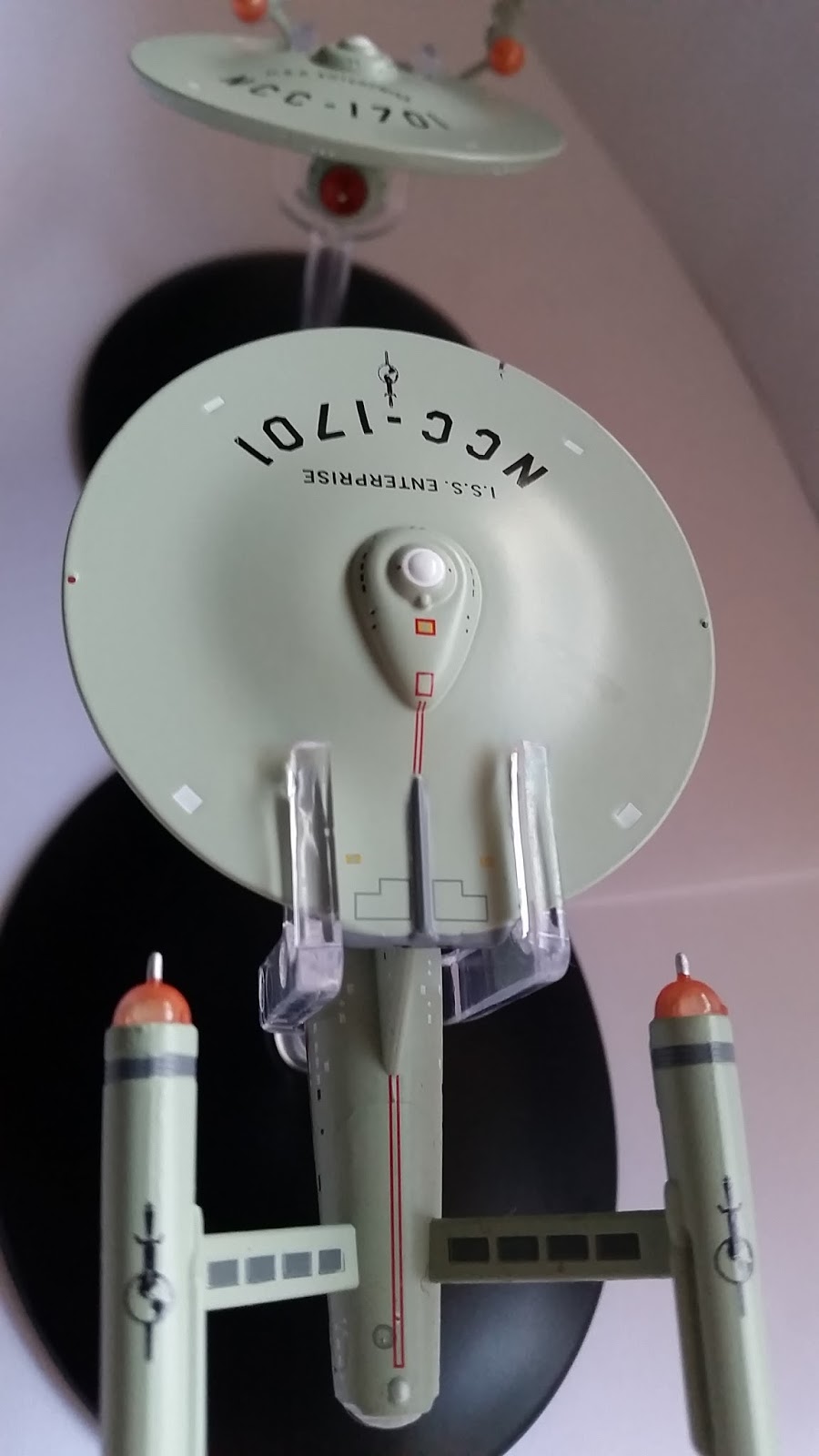
While not a totally new model, the ISS Enterprise special from the Official Starships Collection arrived this week.

TOS on the left, Mirror on the right
The original Constitution Class ship launched as the 50th issue (seems a long time ago now) but this marks the first web-shop direct special starship available to fans - and no, I haven't forgotten about the shuttles.

At the same price as a regular issue plus the delivery fee there's not really much to grumble about when it comes to the cost of this "M1" issue. OK, some might complain because we've effectively had this one already but there are some significant differences that make it well worth adding into your collection.

So let's take a trip back to a time before Deep Space Nine crossed over and brought us the Intendent, a time before we cringed at the idea of letting Quark loose on the Other Side in The Emperor's New Cloak and after/before Enterprise nailed it with In a Mirror, Darkly. A much simpler, more brutal time if you will...

First up there is the obvious name change from USS to ISS. It's not mind-blowing and is only a letter different but I can't remember the last time someone dared to produce it. But that's the smallest change as we also have a new set of Terran Empire world/dagger emblems in black emblazoned across both nacelles and at the front of the saucer.

Finally to the nacelles where the Mirror Universe ship has retained the bussard collector aerials and the grid exhausts to the rear in the style of the model as was for The Cage and Where No Man Has Gone Before. Sadly though the oversized deflector dish noted in the magazine has not made the transition into die cast.  Essentially this is the USS Enterprise from The Original Series and issue 50 with different engines and some restickering which means that deflector omission does sting a little bit. Had it been included then this would have been a perfect reproduction but I do feel a little chested since it isn't.  Add to that the point that the colour of the dish is also incorrect and therefore uncorrected from the issue 50 release. Damn. 

TOS on the left, Mirror on the right
As for build quality it is identical to its Prime Universe counterpart even down to some iffy seams on the port side. The stand clip for the saucer will need some filing down again as it's a tight fit and will scuff the dish at the rear.

Compared to the minimal shuttles magazines,  the "M1" issue is an excellent read. Missing out the standard ship views in favour of content (yes, actual content), it's a more than admirable companion to Mirror, Mirror.  Taking us through the details of the ship and the differences to the USS Enterprise, we also get a chunk of info into the Mirror crew, as well as the story behind the classic second season episode. There's more importantly a glimpse of what could have been if William Shatner and the Reece-Stevens had completed their Mirror Universe episode. This is the key piece in this magazine because it - allegedly - was tantalisingly close to happening in season four. Instead we got In a Mirror, Darkly which isn't a bad thing but that potential Kirk return remains a tempting morsel of Enterprise that could have been.  Well worth a note is the artwork here with some spectacular original images of the ISS Enterprise in CG and from the remastered episodes (which are getting some decent exposure recently in the main issues).

This special will not be for everyone since it does duplicate 95% of the 50th issue model but does have those little tweaks that will draw fans to it because it reflects not just the possible from the Mirror Universe but also the original design of the ship for the two pilots (If you are looking to a more detailed review on the main body of the model I didn't want to repeat myself so you can find that under the issue 50 review). To conclude, I'm pretty pleased with this as a package. Not too expensive, well presented and oddly under-marketed it's a completists delight if only for the minor alterations.

Added the ISS Enterprise to your fleet? Was it worth the purchase?

You can subscribe to the Starships Collection by following the link in the sidebar to the left.

Live on YouTube
Like our page on Facebook 
Follow us on Twitter
+1 us on Google+
Add us on Tumblr
Add to to conversation on Star Trek: Risa

viernes, 15 de enero de 2016

«Empezamos a tener la tecnología para descubrir vida en otros planetas»

El astrónomo Borja Tosar dice que «Interstellar» supone una revolución en el género de la ciencia ficción

La noche del estreno de la última entrega de Star Wars, Borja Tosar (Sarria, 1978) fue a ver la película con unos colegas. Le gustó, pero este astrónomo experto en planetas prefiere Star Trek. «Star Wars es una aventura en el espacio, pero Star Trek muestra el espacio como aventura», explica. El sueño de descubrir nuevas estrellas o planetas es lo que le seduce porque, como dice, «la ciencia es algo muy emocionante».
-¿Y por qué quiso ser astrónomo?
-No hay un porqué. Siempre lo fui. Soy de Sarria y desde allí se ven muchas estrellas.
-¡Qué casualidad! Yo soy de Baralla, al lado.
-Pues ahí también se ven muchas. Al mirar el cielo flipaba. Después veía muchas películas de ciencia ficción y los documentales de Cosmos...
-Dice que veía muchas películas, ¿cuáles son sus favoritas?
-La que más me impactó fue Star Trek; la cuarta es mi preferida. La escena en la que contactan con las ballenas...
-¿Y de las que se han estrenado últimamente?
-Interstellar, de Christopher Nolan, es toda una revolución en el mundo de la ciencia ficción.
-Desmenúcenos la película desde el punto de vista de la ciencia.
-Primero hay que tener en cuenta que un científico como Kip Thorne, el mayor experto en agujeros negros del mundo, fue uno de los guionistas, además de coproductor. Eso es un cambio muy importante a la hora de hacer películas de ese tipo porque por primera vez un científico está directamente implicado en la realización del producto, no es solo asesor.
-Luego todos los protagonistas son científicos...
-Eso mola mucho porque no hay ningún friki. Aparecen como gente normal porque somos gente normal.
-A mi me fascinó cómo trata el concepto de la dilatación temporal.
-Es que la película se atreve con conceptos muy complicados que nunca antes fueron explicados de esa forma. Y lo cuenta desde una perspectiva muy realista. La dilatación temporal debida al campo gravitatorio es un ejemplo. Porque el tiempo es totalmente relativo. Luego, los agujeros negros están perfectamente conseguidos. De hecho, lo más relevante de Interstellar es que es una película de la que ha salido ciencia.
-Por ejemplo...
-La recreación que hace de cómo actúa la luz dentro de un agujero negro le ha permitido escribir varios artículos científicos sobre el tema. Los efectos especiales son tan buenos que se descubrieron muchas cosas.
-¿Realmente una hora en determinados planetas podría equivaler a siete años en la Tierra?
-El tiempo depende del campo gravitatorio y de la velocidad. Por tanto puede haber algún planeta en el universo en el que ocurra eso. En la ingeniería diaria encargada de los satélites GPS hay que tener en cuenta ya ese efecto. En ese caso la diferencia es de segundos. No hay nada inventado en la película.
-Incluso que algún día tengamos que buscar un nuevo lugar para vivir porque ya no podemos continuar en la Tierra.
-Los planetas cambian y se metamorfosean. Marte y Venus fueron como la Tierra. El primero es ahora un desierto congelado y el segundo registra temperaturas de 400 grados centígrados. Puede llegar un día, dentro de millones de años, que eso ocurra en la Tierra.
-¿Y cree que puede haber vida en otras galaxias?
-Un científico no debe creer, debe saber. Hoy en día la única vida que conocemos está en la Tierra. No hay ni el más mínimo indicio de que haya vida en otro lugar. Pero es verdad que comenzamos a tener la tecnología para descubrir vida en otros planetas. Por tanto, puede que se descubra mañana o dentro de años.

¿Te gusta Star Trek? Si es así, hay un nuevo juego Android que no debes perderte


Son muchos los seguidores de Star Trek, una de las sagas especiales más longevas e interesantes que jamas se han creado (junto a Star Wars, claro). El caso es que si este tu caso y tienes un terminal Android es posible que formes parte de la Flota Estelar con un nuevo juego para el sistema operativo de Google: Star Trek: Timelines.


Este es un desarrollo en el que prima la estrategia, por lo que no se debe esperar el poder pilotar las naves en primera persona y, por lo tanto, tampoco el sentir la acción de tener los mandos de la Enterprise. Eso sí, cuando hay enfrentamientos, estos se representan en entornos en tres dimensiones, por lo que la calidad del título es grande (y, por extensión, es recomendable utilizar un terminal con procesador de cuatro núcleos para sacarle partido al juego basado en Star Trek del que hablamos).
Arte en Star Trek Timelines
En cuanto al resto de los requisitos, hay que decir que estos son bastante ajustados, ya que con disponer de Android 4.1 o superior y 40 MB de espacio libre, es posible disfrutar de Star Trek: Timeline. Por cierto, la descarga en Play Store la puedes hacer utilizando la imagen que dejamos a continuación:
Developer: Disruptor Beam
Price: Free*

Así es el juego basado en Star Trek

Un buen detalle que hace que todo tipo de usuarios se pueda decidir por darle una oportunidad es que la traducción del título es completa, por lo que no se tiene la barrera del idioma para poder jugar de forma sencilla. En lo que se refiere al guión en el que se basa, hay que decir que no varía mucho respecto a lo que se ha visto en las películas: hay misiones que se deben resolver y, para ello, se deben utilizar las habilidades de la tripulación que se tiene (en la que hay personajes muy conocidos de Star Trek, tanto en la saga orinal como en las más actuales).
Gráficos del juego Star Trek Timelines
Un buen detalle es que no sólo es posible tomar los mandos de las naves de la Flota Estelar, ya que también en el juego es posible darle uso a los Cubos Borg o a los Ave de Presa Klingon. Por lo tanto, todo el espíritu de Star Trek está presente. El apartado estratégico está presente ya que es necesario el gestionar los recursos que se tienen y, también, el uso de las posibilidades de cada tripulante en el momento preciso.


El arte de Star Trek: Timelines es realmente llamativo y, visualmente, el juego es muy atractivo (sin que le falten creaciones en tres dimensiones bien acabadas). Además, el sonido me ha gustado mucho, ya que desprende todo el “aroma” de las películas. Otros juegos para el sistema operativo de Google los puedes conocer en este enlace de Android Ayuda.

miércoles, 13 de enero de 2016

          13 enero, 2016 at 12:16

Recuperan datos antiguos de Star Trek ¡en 200 diskettes

En el año del aniversario número 50 de la serie original de Star Trek, se recuperó la información de 200 diskettes de su creador. ¿Qué tendrían adentro?

star trek
El creador de Star Trek, Gene Roddenberry fue un prolífico escritor y productor para televisión, y con su obra maestra cautivó a varias generaciones de fanáticos desde 1966. Roddenberry comenzó escribiendo sus guiones en una máquina de escribir, pero al avanzar la tecnología, decidió adaptarse a la computación y trabajar en unas computadoras hechas a medida, guardando su información en diskettes. Entonces ¿por qué no se encontró antes esta información?
Durante la primera semana de este año las empresas DriveSavers y eDiscovery anunciaron que por fin habían podido extraer la información guardada en los diskettes personales de Roddenberry, que aparecieron mucho después de su muerte en 1991. Y aquí entra en acción otro problema: les contamos antes que el escritor de Star Trek usaba computadoras personalizadas, esto supuso una gran dificultad para los investigadores, ya que no solo el hardware era totalmente distinto a las unidades de mercado, sino que también el software y los diskettes fueron hechos a medida. Para completarla, una de estas dos computadoras personales fue vendida en una subasta hace muchos años, y la que pudieron conseguir… no funcionaba.
spock star trek nimoy culturageek.com.ar

RELACIONADO: En Julio llega la Star Trek original a Syfy

Luego de recibir los 200 discos, comenzó una ardua tarea de desencriptación, ya que los ingenieros no tenían documentación de ningún tipo sobre el funcionamiento de los equipos o el software. Durante más de tres meses el equipo de DriveSavers desarrolló un software desde cero para poder leer los discos, seguido de un año de leer y procesar toda la información que había dejado Roddenberry.
¿Y entonces? ¿Qué encontraron? Mike Cobb, director de ingeniería de DriveSavers no quiso revelar sus hallazgos, pero dio un par de pistas: “Encontramos muchos documentos, y 2016 es el aniversario número 50 de la serie original de Star Trek. Cualquier cosa podría pasar, pero el mundo va a tener que esperar para ver“.
Mientras tanto, Paramount Pictures lanzará el nuevo reboot “Star Trek Beyond” este año, y CBS anunció hace poco que planean lanzar una nueva serie de esta franquicia en CBS All Access en 2017.

lunes, 11 de enero de 2016

Mondo to release vinyl Wrath of Khan soundtrack 

1Wok-Front--FINAL2
Mondo is releasing a very special vinyl version of the soundtrack to Star Trek II: The Wrath of Khan, and we have images and details to share.

From Mondo’s press release:
2016 marks the 50th Anniversary of Gene Roddenberry’s inimitable Star Trek franchise and Mondo is honored to kick the year off with an expanded soundtrack release of arguably one of the greatest chapters in Trek history: The Wrath Of Khan.Composed by the late great James Horner, The Wrath Of Khan is an essential motion picture soundtrack. As he would be asked to do for the Alien franchise a few years later, Horner was brought in to replace Jerry Goldsmith, who composed the previous entry Star Trek: The Motion Picture. Horner was able to produce one of the greatest Trek scores in the now 50-year-old franchise, while also catapulting himself from an unknown into one of the greatest American composers of our time.This deluxe re-issue is pressed on 180 Gram 2XLP Mutara Nebula colored Vinyl, features original artwork by Matt Taylor, exclusive liner notes by Devin Faraci, and has been remastered for Vinyl by James Plotkin.

The 2-LP set features 23 tracks spread over 4 sides:

01. Main Title (3:06)
02. Surprise on Ceti Alpha V (0:45)
03. Khan’s Pets (4:19)
04. The Eels of Ceti Alpha V / Kirk in Space Shuttle (3:53)
05. Enterprise Clears Moorings (3:33)
06. Chekov Lies (0:40)
07. Spock (1:12)
08. Kirk Takes Command / He Tasks Me (2:07)
09. Genesis Project (3:16)
10. Surprise Attack (5:07)
11. Kirk’s Explosive Reply (4:01)
12. Inside Regula I (1:35)
13. Brainwashed (1:24)
14. Captain Terrell’s Death (1:58)
15. Buried Alive (0:57)
16. The Genesis Cave (1:09)
17. Battle In The Mutara Nebula (8:07)
18. Enterprise Attacks Reliant (1:29)
19. Genesis Countdown (6:34)
20. Spock (Dies) (1:53)
21. Amazing Grace (1:26)
22. Epilogue / End Title (8:41)
23. Epilogue (Original Version) / End Title (7:29)
The set will cost $35 and will be available for purchase at Mondotees.com on January 13. The extremely cool Mutara Nebula colored vinyl is limited.
9WoK-Discs1--FINAL2


Llega el primer traductor universal en tiempo real: así es ili


Llega el primer traductor universal en tiempo real: así es ili


La traducción eficiente de idiomas es una de las pocas barreras que todavía se le resisten a la tecnología. Sí, es cierto que los traductores han mejorado mucho y que hemos visto desarrollos tan interesantes como Skype Translator, pero ¿qué te parecería llevar un pequeño dispositivo que traduzca tu voz a otro idioma en tiempo real? No, no es ciencia ficción; se llama ili y se empezará a vender este verano.
Sus creadores anuncian ili como el primer traductor wearable. En realidad, se trata de un discreto gadget capaz de realizar traducción instantánea con una gran precisión y sin necesidad de conexión a Internet. Al recurrir a un diccionario interno las respuestas son prácticamente inmediatas y se pueden mantener conversaciones de forma mucho más fluida que usando el traductor del smartphone, por ejemplo.
Se ha trabajado mucho para que el micrófono integrado y el altavoz puedan funcionar bien en entornos ruidosos, como tiendas o una estación de metro. En una primera fase ili funcionará con los idiomas inglés, japonés y chino para, más adelante, atreverse con el italiano, árabe, tailandés, coreano y español.
Aunque el invento es interesante y las pruebas en vídeo os sorprenderán conviene no llevarse a engaño; trabajar con diccionarios offline y sin capacidades de procesamiento en tiempo real vía cloud tiene sus limitaciones. No parece que, al menos de momento, ili vaya a quitarle el trabajo a los profesores de inglés, pero si será de gran ayuda para los viajeros, la asistencia hospitalaria, las tiendas o los hoteles.

viernes, 8 de enero de 2016


Access Hollywood makes visit to Star Trek Beyond set 


mantz

Access Hollywood got an exclusive look behind the scenes of Star Trek Beyond, and we have the clip.


Access Hollywood film critic and longtime Trekker Scott Mantz paid a visit to the STB set while the production was shooting in Vancouver, and got a chance to speak with Chris Pine,  Simon Pegg, and Karl Urban about what’s in store for the crew of the Enterprise:

New Three-Disc STAR TREK: NEXT GENERATION Soundtrack Coming From La-La Land Next Week!


It's a new year, and as we've been expecting for some time, La-La Land has just announced a new Star Trek: The Next Generation soundtrack collection going on sale January 12!
tng-vol2
January 12, 2016 brings us our first release of 2016. (It will be the only title released in January).
La-La Land Records and CBS are kicking off the 50th Anniversary of Star Trek in style with:
STAR TREK: THE NEXT GENERATION VOLUME 2 - 3 DISC SET
Music by Dennis McCarthy, Jay Chattaway and Geoge Romanis
LLLCD 1377
Limited Edtition of 3000 Units
Retail Price: $34.98
The first 200 or so customers who purchase this cd directly from www.lalalandrecords.com will receive a signed copy autographed by composer Dennis McCarthy at no extra charge. Quantities are limited and you are not guranteed a signed edition.
This title goes on sale next Tuesday, January 12, 2016 at 12 pm pst. www.lalalandrecords.com
Following up to their 2011 "Volume 1" TNG release, La-La Land has already provided a list of episodes to be represented in this new set:
DISC ONE: MUSIC BY DENNIS McCARTHY
1. STAR TREK: THE NEXT GENERATION
Main Title (2nd Season)
Music by Alexander Courage and Jerry Goldsmith
Arr. Dennis McCarthy
2 – 6. THE LAST OUTPOST
7 – 10. HOME SOIL
11 – 12. PEN PALS
13 – 14. PEAK PERFORMANCE
15. FAMILY
16. THE WOUNDED
17 – 21. CAUSE AND EFFECT
22. SCHISMS
23. LESSONS
Disc One – Total Time: 77:19
DISC TWO: MUSIC BY JAY CHATTAWAY
1 – 2. IN THEORY
3. THE GAME
4 – 8. POWER PLAY
9. TRUE Q
10 – 11. CHAIN OF COMMAND, PARTS I & II
12. LESSONS
13. FRAME OF MIND
14 – 15. GAMBIT, PARTS I & II
16 – 17. EMERGENCE
18 – 19. PREEMPTIVE STRIKE
20. BONUS TRACK: GAMBIT, PART I
Disc Two – Total Time: 75:34
DISC THREE: UNFINISHED BUSINESS
1 – 6. TOO SHORT A SEASON
Music by George Romanis
7 – 10. HIDE AND Q – Music by Dennis McCarthy
11 – 14. CONSPIRACY – Music by Dennis McCarthy
15 – 17. THE SURVIVORS – Music by Dennis McCarthy
18. THE CHILD – Music by Dennis McCarthy
19. STAR TREK: THE NEXT GENERATION
End Title (3rd Season, Short Version)
Music by Jerry Goldsmith, Arr. Dennis McCarthy
Disc Three – Total Time: 75:48
Total Time – All Discs: 3:48:41
div_spacer

miércoles, 6 de enero de 2016

William Shatner won't be back as Kirk in Star Trek Beyond

Don’t look for William Shatner to boldly go in Star Trek Beyond.
Despite early rumours that had him poised to reprise the role of James T Kirk for this year’s 50th anniversary adventure, Shatner tells SFX magazine that he won’t be beaming aboard the Enterprise’s next big screen voyage.
“There was never a conversation,” he says, claiming he had no involvement in preliminary plans to resurrect the iconic character in the rebooted movie universe.
While his late co-star Leonard Nimoy made nostalgic cameos as Spock in 2009’s Star Trek and 2013’s Star Trek Into Darkness, Shatner last wore the Starfleet uniform in 1994’s Star Trek: Generations, the film that saw Kirk unceremoniously offed by Malcolm McDowell’s scheming Dr Soran.

“It would have been interesting to see what their fertile imaginations could have done with somebody who is 20 years older than when Captain Kirk died [in Star Trek Generations] and how they would have explained the difference in appearance. But that never came up. I’m sure they must have thought of it one time or another but I never had a substantial conversation about replaying the role.”
Shatner’s return was said to be key to a storyline developed by Star Trek Beyond’s original helmer Roberto Orci, subsequently replaced in the director’s chair by Fast And Furious supremo Justin Lin. The movie now has a brand new screenplay co-written by Trek star Simon Pegg.
Shatner came close to reprising his most enduring role in 2009’s reboot. The film’s writers drafted a scene where Nimoy gave Zachary Quinto’s Spock a pendant containing a holographic pep talk from the original Jim Kirk. The scene was never filmed.