miércoles, 20 de enero de 2016

Best Of Both Worlds Could Have Been Longer

Memos between Ron Moore and Michael Piller reveal that The Next Generation‘s The Best of Both Worlds could have been longer than two episodes.
Originally, the story arc might have run to three or four episodes.
“I believe that we should stretch out this dramatic line as long as possible,” said Moore in the memo. “I am firmly in favor of a Part Three and Four to the story. I think that the Borg invasion of Earth (and by extension the Federation) will give us an opportunity to do stories that will stretch our characters and inject new life into the series overall.”
Riker would have been the beneficiary of a longer story. “an extended stay in the Captain’s chair…would help to define his character,” said Moore.
The story would have evolved “into a deadly chess game between the master and the student. Piker versus Riker.”
Both memos can be seen at Mission Log Podcast.

martes, 19 de enero de 2016

 Impossible Threat? Borg Tactical Cubes in Attack Wing


What’s worse than a Borg Sphere? A Borg Tactical cube! The armoured nightmare, making its only appearance in Unimatrix Zero, has actually received two versions for Attack Wing as Dan and Clive explain...


The first version, Tactical Cube 138, was released last year into retail and, while we only ever saw one cube on screen, Wizkids have released a second, Tactical Cube 001. This edition however was given to overall winners of their Resistance is Futile OP event. So let's take that retail version first. 

What is immediately apparent before you even open the packet is the size of the cube itself. Significantly larger than the standard ships but still a fair margin off the oversize cube, the Tactical Cube is a formidable and intimidating presence in Attack Wing and that's before you take a look at its features. The plastic base is also larger than normal to accommodate that armoured shell and increased size.

Weighing in with six attack and zero defence you might think that WizKids have made the Borg noticably arrogant (and overpowered) in their gaming form but with nine hull points and eight shield points to beat it certainly balances the fact that they can't stop an attack on basic ability alone. It weighs in at a colossal 46 points (more than every other ship bar the two oversize craft) so playing a 50 points-per-ship game doesn't give you a lot of room to move here so it's likely to be played in a one vs two (or more) scenario to even the odds.

As with all Borg ships the cube offers Target Lock, Scan and the vital Regeneration plus the unique feature that the Borg Ablative Armor upgrade in the pack costs three less points to equip. Along with that Borg upgrade you can add on three weapon, one tech and another Borg card to your ship. For smooth moves you have everything forward and at 90 degrees between speeds one and four plus reverse up to speed three which is certain to play a part given very few other ships can manage such feats. The higher end forward and back speeds do lumber you with an auxiliary power token but given your fire-power and upgrades there's not a lot you're going to worry about here.

If you're looking for a detailed model then I would push you more towards the recent Eaglemoss cube. Although a bit smaller it's a better replica with much finer attention to detail on the surface and, I suspect, a closer tie to the screen appearance. Leading your charge there are a couple of choices. At the head of that queue is the Borg Queen (Susanna Thompson version).

What you need to appreciate with the Borg as we look at the captains is the use of Drones. Each Borg captain is assigned a certain number of Drone tokens at the start of the game and these can be spent during the game. It might be a free action or the level to which an upgrade can be effective but we'll come to each as we meet it on each ship. What spending a token means is that your Captain Skill decreases every time one is used.


So to the Queen because she allows you to spend one of those tokens to perform a free action. Also if the ship on which she is assigned gets destroyed then you can switch the Queen over to another Borg vessel in your fleet replete with her full compliment of eight Drone tokens. Starting with eight tokens the Queen costs a high six points but does have that amazing flexibility plus an Elite Action slot.

Your other option is to take on the Tactical Drone at a cost of four points and a starting skill of six. With this captain you can spend three of those tokens to maintain your target lock after it's been spent. Not sure how big an advantage this is compared to some of the other Borg command options and I'd rather spend another two points for the Queen.

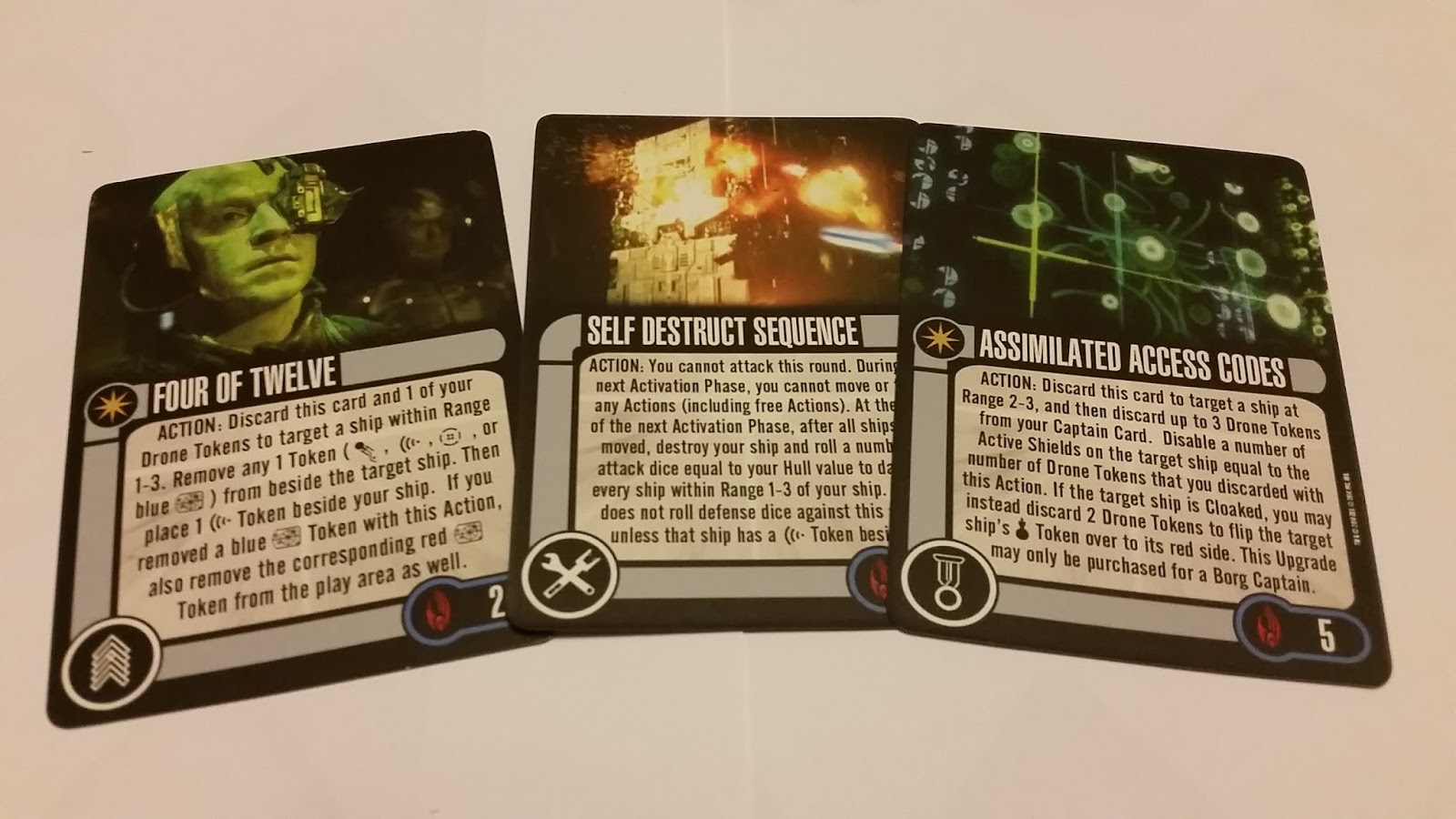
The solo Elite Action is Assimilated Access Codes which comes at a cost of five squadron points and a discard. Up to three Drone Tokens can be used here to disable an equal number of enemy shields or you can flip a cloak token. Handy little upgrade but a hefty cost for one use when it would be cool to have it for a couple of goes at least. Definitely one for use against Romulans or Klingons I would hazard.

You kind of get the feeling this pack was designed with one thing in mind and that's more obvious as you only get one crew card, Four of Twelve, who, once more, is a discard for a more appetising two point cost. You'll need to spend one of those scarce Drone Tokens too if you want to remove an Evade, Scan, Battle Stations or, more enticingly, a Target Lock token from beside your intended victim. Considering the lack of defence on the cube this would be one to keep in the back pocket when things start to look a bit grim since it might mean the difference between escape or defeat especially if you can remove offending target locks.

Also solus to the pack is Self Destruct Sequence as your only Tech upgrade. Cancelling the chance to move or act it comes into play at the end of the Activation Phase once everyone has moved. You then roll the number of dice equivalent to your hull value (a staggering NINE in this case) which then damages every ship within range three. Nor can the enemy defend against this unless it has a Scan token assigned. Undeniably a huge endgame suicide move I guess this is a big decision especially if you're firing all nine results at each ship individually. Thing is the card doesn't specify if you need to split the result or not. I'd say not but heck it's not one many will walk away from.


The larger number of upgrades with the ship come in the Borg and Weapon upgrades (surprise, surprise) and if you're looking for inexpensive and reusable the best start is Borg Alcove. An Action card it allows you to add a Drone Token back to your captain but no more than the original starting number. No catch either and no discard or disable so you can effectively use this every single round and it only costs four points. Just have to wonder if you'll have enough slots/upgrades to utilise this properly. Secondly there's Borg Ablative Hull Armour. Additional defence plating is a bit of a recurring theme in Attack Wing with Voyager, Defiant and Prometheus being three ships I can immediately think of that carry the card or its near-as-dammit equivalent. Converting critical damage hits into normal damage will keep your cube going a bit longer without too many technical hitches and increases your shielding/hull by a further four points. Worth it for a ten point super-cost? Probably since your came might keep running a bit longer BUT you are taking a huge point hit for the feature.

The killer Borg Tractor Beam we first saw in Q Who makes a slicing appearance here and costs a large seven points but you don't need to disable or discard this either after just one round. Effective at the rather close-for-comfort range one there's no condition to its activation. If you want it, stick the included tokens next to your Borg ship and the target vessel. 

Notably it works against cloaked ships and disables two the craft's shields. Nor can shields be raised or a cloak initiated while the beam is active. But what else does it do? It restricts the enemy movement to just speed two and allows you to implement the stupid-weapon-of-total-destruction, the Cutting Beam. Now talking of huge costs with the Ablative Hull Armour, this takes eight points BUT you'll have to have the seven point Tractor Beam as well. This makes the ability to use this ten dice attack at 15 points all-in. Luckily it's "only" a disable and not a discard or there would have been blood and is an unusual two-card combo which relies on a high price. However, it's going to be ridiculously effective even if you are going to need to be at touching distance to use it.

Rounding out your Tactical Cube are two cards each with a six point cost and part of your Weapons choices. Borg Missile drops a four dice attack within range two but before you wonder why you would drop two dice from a primary attack for this, hear me out because this one is probably worth a shot. For each normal or critical damage result you get to slap an Auxiliary Power Token and obliterate an active shield plus there's no defence roll so you're almost guaranteed to do some damage. It's a fine example of how over-powered the Borg are in Attack Wing and certainly something to make them feared. I'd hate to run into a cube armed with this and that Cutting Beam - but considering the massive costs that's not very likely. 

Final Assault does equal your primary weapon roll with six dice and insists (yes, really) that you split the result between two or three different ships. Big revolutionary move allowing a double/triple attack on one shot. Worse is that if you play this on the Tactical Cube you get to use nine - I said NINE - dice to throw around. Blub. You're dead.

Closing the expansion is the Deliver the Nano Virus scenario which takes its lead from  Unimatrix Zero. While I don't enjoy that two-parter that much the mission is great to play as your Federation player hops on and off the cube to thwart the Collective. Having a two-on-one scenario is a must or the Federation player would be screwed in about four goes. Luckily having backup means there's a fair chance for success especially if you choose to play by the amended Borg rules which I did to see how they would work. For note I stuck the Thunderchild and the Defiant against it and won. Just.

So, Dan...what's the deal with this prize cube?

The second cube, the prize expansion, has a lot of cards that are themed around First Contact. Firstly in command is the Borg Queen, based on Alice Krige’s portrayal of the role. Like most of the Borg captains, she comes with a set number of drone tokens, the starting number (in this case nine) represents their Captain Skill.

You spend a drone in order to do the actions on the relevant card, thus reducing your Captain’s initiative. For example, this Queen card allows you to spend six tokens in order to disable two upgrades on an enemy ship. A nice ability, however, it’s fairly situational. You have to be in range one, and it maybe that the target ship doesn't have any upgrades to disable. Also, by spending those drone tokens, it does reduce the Queen to a skill level three, meaning that unless you have an upgrade that allows you to increase drone tokens, she will be a level three for the rest of the game.

Another upgrade is a Borg version of Data, representing our favourite android during the 0.68 seconds when he was tempted by the Queen. In this pack, he allows you to spend a token in order to disable a nearby captain and take a free scan action. A nice upgrade, and one that works very well with the Queen who has nine tokens to spend. The elite talent (command interface) lets you discard it to re-roll a single dice.


I don’t like this one as five points seems like a steep price for re-rolling a single dice once per game, especially when Interplexing Beacon lets you do much the same thing, but at range 3 for 3 less points and 1 to 2 tokens for 1 to 2 dice respectively. Finally, rounding out the pack is the Borg Maturation Chamber. This Borg upgrade allows you to regenerate all of your drone tokens. At six points, it is a bit expensive, but its nice if you need to get your Captain’s drone levels back up. Lastly, versions of the Borg Tractor Beam, Borg Cutting Beam and Borg Missile are included here. 

The ship itself allows you to discard your Borg upgrades to cancel opponents hits or critical hits. A nice ability for a last ditch situation, but if I were playing Borg in a situation like this, I would try to get away from my opponent and use the regenerate ability before returning to the fray. 

The ship physically differs from the retail cube in that it is made of translucent green plastic. It’s difficult to convey in photographs, but it looks different enough from the previous version. Online videos have shown many hobbyists breaking their Borg ships open and installing green lights in order to give their ships a green glow. While I would never dream of attempting this myself, this cube is probably more conducive towards that end. 

How does this ship play? Well, her high points cost puts her in the same bracket as Deep Space Nine, meaning that you get to put up to eight points of upgrades on there (if you're playing 50 points per ship), hence my unhappiness with the high cost of the various upgrades on here. 

The ship is further hampered in tournament play by changes to the overall rules that affect the Borg. Firstly, ships with a base 360 degree firing arc can now only fire at a maximum range of two. Secondly, the Borg movement mechanic has been changed so that instead of spinning and then moving, ships move then spin, meaning that a Borg Cube will usually only go backwards or forwards. 


Having run this ship in tournament play, I can confidently say that she is still a formidable beast. With 8 shields and hull she can take a pounding, and with six attack dice she can give them out too. However, with no evade, she won’t last forever...

There we have it - the two available Tactical Cubes. Horribly over-powered and under-defended but hey, at least it gives the other players a bit of a chance to win.

lunes, 18 de enero de 2016

EXCLUSIVE: 'Star Trek Beyond' Has New Weapons, Uniforms… And a Baby!

domingo, 17 de enero de 2016

Hello, Computer: Just what was that computer Star Trek's Gene Roddenberry used?

We solve the mystery of who made the generic-looking computer that Star Trek's Gene Roddenberry used for years.


5096 0
Was Gene Roddenberry a Mac guy or a PC guy? How about neither?


His vision of the future inspired legions of engineers, nerds, and techies, as well as Bluetooth headsets, the iPad, Siri, and cell phones.
But what kind of techie was the late Star Trek creator Gene Roddenberry in real life? Or more specifically, what kind of computer did the man use?
These questions all bubbled up when Gene Roddenberry’s long-lost floppy disks surfaced. The disks, all artifacts in themselves, were salvaged, but information about the actual computer he used to create them has been a mystery.
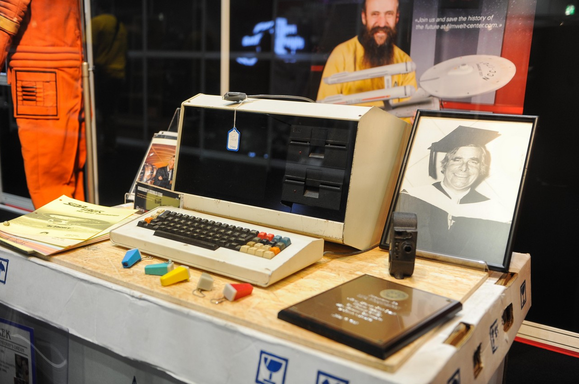
Roddenberry had two of these generic-looking machines. One his estate kept after he died, while the other was sold off in an auction to benefit charity in 2010. For that, auction house Julien’s Live described it as “IBM identification number ‘GS 113302’ dual floppy disk drives with built-in monitor and separate keyboard. This early portable IBM PC retailed for nearly $3,000 in the early 1980s. The metal case has a “GR” handwritten on upper left side, indicating that this computer was owned and used by Gene Roddenberry.”
The auctioned computer appears to have been purchased by a fan, where its notoriety has secured it a spot on the Star Trek convention circuit.
trekmovie
Gene Roddenberry’s computer is important enough that it even made the Star Trek convention circuit in 2014.

That’s no IBM

If you know your computers, you know that’s not an IBM PC. In fact, it’s so generic, you’d think it was one of those plastic props used in an Ikea furniture store to sell Blërg desks.
I consulted our resident vintage computing expert Benj Edwards of Vintagecomputing.com and our own "This Old Tech" column, and even he was stumped by the make of Roddenberry’s computer.
“That’s probably not an IBM compatible machine. It’s likely a very obscure CP/M business machine circa 1978-83,“ Edwards said after seeing pictures of it and being told of the auction house details. His educated guess was a Blackhawk Computer Systems Model III or older running on a Zilog Z-80 processor.
“It’s possible the chassis was generic and it was used by a different company to build a PC compatible machine, but judging by the keyboard, it looks like it even predates the [system Model III].”
And no, it’s not a Daystrom Institute M-5 Multitronic unit from the episode, "The Ultimate Computer."
theultimatecomputerhd0181 Paramount Pictures
The Ultimate Computer in the 22nd century is still a desktop, as we can tell from this M-5 multitronic computer.

The answer is...

So what is that mysterious white box? Gene Roddenberry’s “computer” for many years was a Lexoriter, a dedicated word processor purchased in the early 1980s, according to Susan Sackett.
Sackett should know. She’s the author of several Star Trek books and worked as Roddenberry’s executive assistant from 1974 until his death in 1991.
”[The computer] didn’t do anything else—it was used strictly for writing and saving work on disks,” Sackett told PCWorld. “Later, we added an external modem so we could dial up and chat with other people, but I don’t remember much about that.”
lexoriterb1 Susan Sackett
Gene Roddenberry’s long-time executive assistant Susan Sackett has a good laugh in front of one of the Lexoriter computers the Star Trek creator used.
Sackett said the pair cost about $6,000 to $7,000 and one sat on her desk with a daisywheel printer (later upgraded to a dot-matrix) while the other sat on Roddenberry’s. The disks would be handed back and forth via the classic Sneakernet of the early '80s.
The machine itself, from what I can tell from a 1982 edition of Computerworld, had a Zilog Z-80 processor, two floppies, and the Luxor WP software on a ROM chip. It was touted as being able to interface with the popular electric typewriters of the period. Its maker, Luxor Corp., appears defunct, but the similarities with the chassis used for the CP/M-based Blackhawk Computer System that Edwards thought it was makes me wonder whether Luxor didn’t just source its chassis from Blackhawk.
One thing Sackett is certain of, though: how much RAM the computers had, because Roddenberry would brag about the whopping 64K.
lexoritera1 Susan Sackett
Gene Roddenberry and Susan Sackett in front of a Lexoriter “computer.” If you look close enough you can see the printer to the right of Sackett and the traditional box of  5.25-inch floppy disks.
For the most part, Roddenberry's “computer” was mostly a glorified typewriter, but he put it to good use filling those 200 missing disks.
“Gene constantly upgraded his devices. He used them mainly for writing and rewriting his Star Trek II novel, which was never published, as well as the script, which was never filmed, and for his speeches and general rewrites of all these,” Sackett said. She also ventured a guess as to what is on those disks.
“Sorry to disappoint, but there are no long-lost Star Trek episodes on the disks! I can’t recall specifics, but it would be mostly correspondence, speeches, and script ideas for the next, at that time, movie.”
kaypro10 angle Vintagecomputing.com
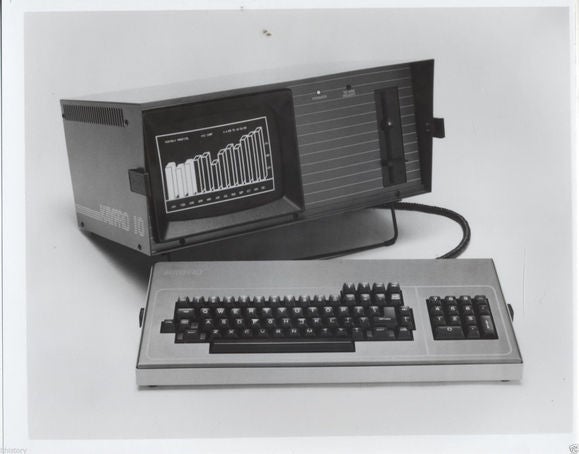
Star Trek creator Gene Roddenberry also bought a Kaypro 10 and asked "Trouble with Tribbles" writer David Gerrold to help him use it.

There was a Kaypro, too

The pair of work “computers” may not have been Roddenberry’s first personal computer, though. Science fiction author David Gerrold, who wrote the classic Trek episode "The Trouble with Tribbles" and helped developed Star Trek: The Next Generation, said he believed Roddenberry’s first personal computer was a Kaypro 10 that was bought in 1983. Knowing Gerrold to be a computer nerd, Roddenberry turned to him for help with the Kaypro 10.
Offering a little more insight on Roddenberry’s computing history, Gerrold said he didn’t recognize the pair of Lexoriters but did say Paramount provided the writing staff with “IBMs” for the work on Star Trek: The Next Generation.
roddenberrymac
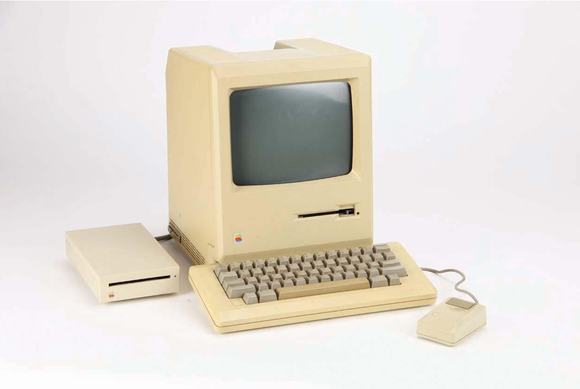
Apple gave Gene Roddenberry a Mac 128K in 1986.

But what about his Mac?

So what we know about The Great Bird of the Galaxy’s computing habits seems to point mostly to business machines. Roddenberry, however, is often associated with Apple’s Macintosh. Roddenberry did own a Mac that was given to him by Apple in 1986. That machine was auctioned off in 2009 to much fanfare and created a minor tizzy when it was wrongfully thought to be the first Mac Plus ever made. A date of 1986, however, would be well after his use of the Lexoriters and Kaypro 10.
Sackett also said she didn’t recall Roddenberry ever using the Mac much, instead continuing to buy newer PCs. Still, Mac fans will always have the one Star Trek memory over the PC and CP/M machines.

 27 Rarely Seen Behind-the-Scenes Photos from the Filming of The Cage (Star Trek: The Original Series)


Digitized film clips, donated images, and other rarities associated with the first pilot. Originally called Menagerie, then The Cage, and later wrapped in a two part series story called The Menagerie, this gallery is composed of souvenirs from the time of the filming of the first pilot original footage in late 1964 and completion of f/x in early 1965.

Spock from The Cage.

From the filming of The Cage, this shot shows the set of the subterranean "cage" area where Captain Pike was held by his Talosian captors. Visible in this shot are the spotlights above the set, the edge of the artificial rock surrounding Pike's cell, and some elements of the soundstage.

In this posed shot on the set of The Cage, Susan Oliver in her non illusion (well, actually her illusion of beauty) dress can be seen on the set of subterranean Talos IV.

A clapper from December 1964, documenting the filming of a scene during the fourth week of shooting of The Cage. This is of course Vina playing the "damsel in distress" role for Pike's illusion version of the battle on Rigel VII.

This shot shows the bridge of the Enterprise from the starboard side railing height.

Janos Prohaska, who also played the Mugato and Horta, played the bird like creature in an adjacent cage under the surface of Talos IV in the first pilot.

A frontal shot of the creature from the adjacent cage from the first Star Trek pilot, The Cage. This costume was originally from The Outer Limits. It was used for this scene where the creature was obviously a fellow prisoner of a different species (this is a different though similar pose to that used) and also was used as an illusion by The Keeper as Pike strangled him.

An historic and previously rarely seen shot of Susan Oliver in fully deformed state makeup and costume holding a sign with an inside joke directed towards Desilu executive Oscar Katz. Oscar Katz knew Gene Roddenberry and is credited with convincing Lucille Ball and others at the studio to take a chance on the original Star Trek concept.

Many visual effects were evaluated before deciding on the final shimmer asssoicated with the transporter beaming process. This was the most colorful, showing what ultimately was a discarded effect using multiple, different color fills for each person within a red outline being "beamed" out or in via a shimmering column.

Majel Barrett in her original role from the Star Trek TOS pilot The Cage, as Number One, shown on the original bridge set of the Enterprise.

One of several optically composited images produced to illustrate the surface of Talos IV on the Enterprise briefing room computer screen after Pike has been taken by the Talosians.

A very early clapper from what I believe is the second day of filming for The Cage in 1964. This scene shows Laurel Goodwin as Yeoman Colt and Majel Barrett in her original role as Number One, a lieutenant, executive officer, and presumably second in command, in the briefing room of the Enterprise after Captain Pike has been captured on the Talos IV planet surface.

This shot shows the construction of the set used for the filming of the original 1964 pilot The Cage.

This shot shows a wide view of the set of the briefing room of the Enterprise, during the scene that discusses the fact that Captain Pike has gone missing on the surface of Talos IV.

In this shot, Number One and Yeoman Colt both are symmetrically stepping off the transporter platform.

This very early shot of the filming set for the transporter room aboard the Enterprise dates back to 1964 and the production of the first pilot (known originally as The Menagerie, then The Cage).

Majel Barrett, Leonard Nimoy, and Jeffrey Hunter are visible in the shot, but in addition one can see both a sound boom and wires that presumably carry the power that is illuminating a number of the controls at the helm and weapons stations.

A rare and beautiful clapperboard from the later December fourth week of filming (!!) of the first pilot The Cage.

A restoration of a badly decomposed clip showing filming of The Cage in December 1964.

The laser canon, pre-fx shot, from the surface of Talos 4, from the pilot The Cage, later reworked into the TOS episode The Menagerie.

Clapper scene start up of the Talosians under the surface of Talos IV from the filming of the first pilot The Cage for Star Trek.

Iconic Star Trek TOS image, an illusion recreating a castle and battle with hostile warriors on Rigel VII, now with Vina to protect, as put in the mind of Christopher Pike by Talosians in the first pilot, The Cage.

A servant feeds Christopher Pike fruit in the Vina as Orion slave dancer illusion from the first pilot, The Cage. This scene and the servants were not shown, even in the pilot reel. Note the multiple eyebrows!

In the Orion slave dance illusion, the script calls for an introduction that shows servants attending Pike, Vina as the slave dancer coming out and acting cat like and snarling at them to chase them away, Pike's personal servant brandishing a whip to settle her down and focus on her dance, and ultimately her doing the dance we see in the pilot.

This shot is taken after the scene has finished (maybe it is before the start), as Susan Oliver walks from or towards her mark and stares down at her nails smiling (red lips show up well contrasted to her green face).

A clapper from the filming of the first piloit setting up Vina's dance. Susan Oliver's expression, nails, and one of the band members make this an interesting and historical shot from one of the iconic early TOS moments.

Another unused shot from the various sensuous dance moves executed by Susan Oliver as Vina for the illusion sequence from the original filming of the first pilot, The Cage. In this shot the band and instruments can be seen in the background, and most obvious here are the long and (of course) green nails both shadowed and reflected in the stairs and floor below.

sábado, 16 de enero de 2016


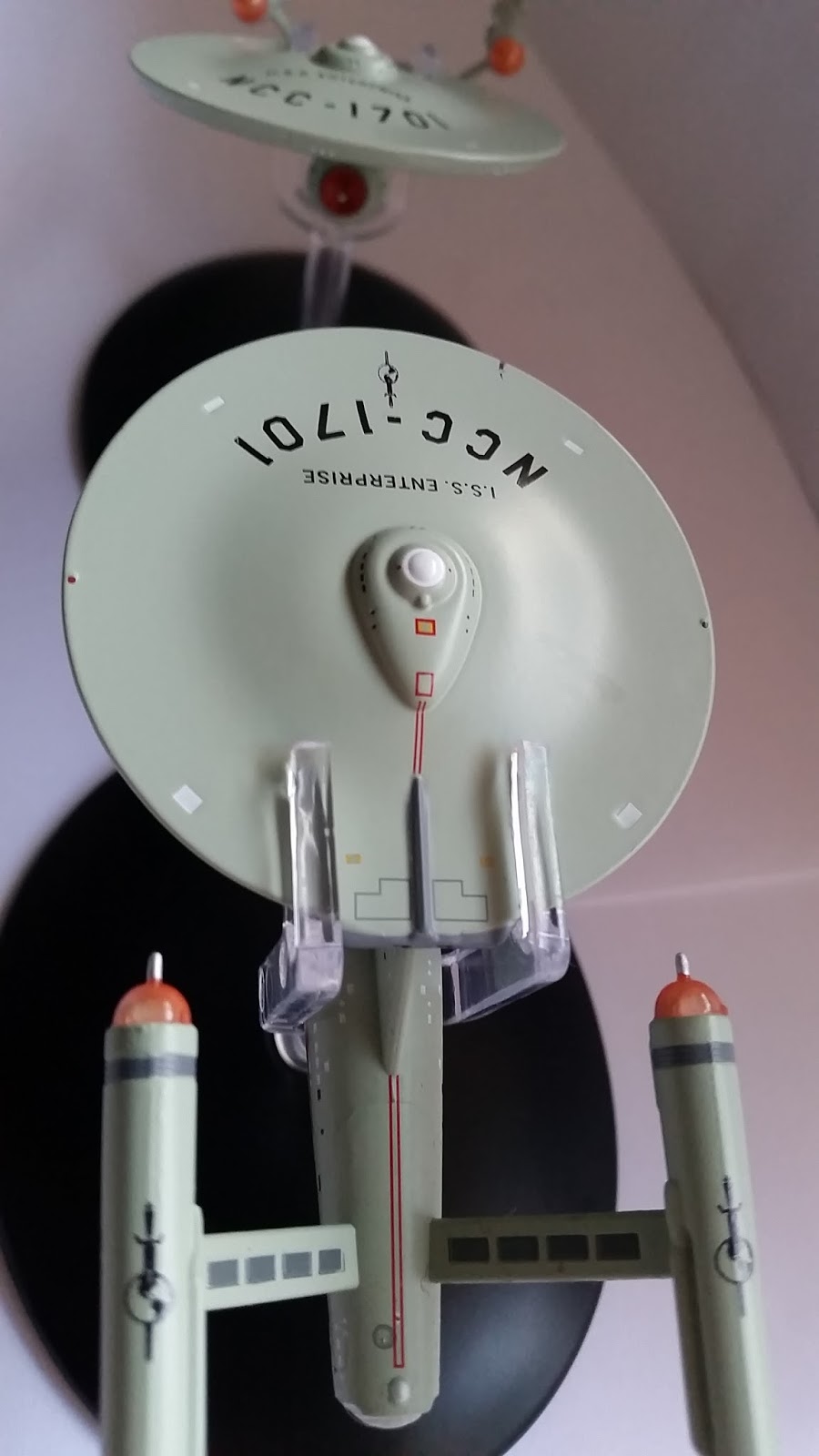
While not a totally new model, the ISS Enterprise special from the Official Starships Collection arrived this week.

TOS on the left, Mirror on the right
The original Constitution Class ship launched as the 50th issue (seems a long time ago now) but this marks the first web-shop direct special starship available to fans - and no, I haven't forgotten about the shuttles.

At the same price as a regular issue plus the delivery fee there's not really much to grumble about when it comes to the cost of this "M1" issue. OK, some might complain because we've effectively had this one already but there are some significant differences that make it well worth adding into your collection.

So let's take a trip back to a time before Deep Space Nine crossed over and brought us the Intendent, a time before we cringed at the idea of letting Quark loose on the Other Side in The Emperor's New Cloak and after/before Enterprise nailed it with In a Mirror, Darkly. A much simpler, more brutal time if you will...

First up there is the obvious name change from USS to ISS. It's not mind-blowing and is only a letter different but I can't remember the last time someone dared to produce it. But that's the smallest change as we also have a new set of Terran Empire world/dagger emblems in black emblazoned across both nacelles and at the front of the saucer.

Finally to the nacelles where the Mirror Universe ship has retained the bussard collector aerials and the grid exhausts to the rear in the style of the model as was for The Cage and Where No Man Has Gone Before. Sadly though the oversized deflector dish noted in the magazine has not made the transition into die cast.  Essentially this is the USS Enterprise from The Original Series and issue 50 with different engines and some restickering which means that deflector omission does sting a little bit. Had it been included then this would have been a perfect reproduction but I do feel a little chested since it isn't.  Add to that the point that the colour of the dish is also incorrect and therefore uncorrected from the issue 50 release. Damn. 

TOS on the left, Mirror on the right
As for build quality it is identical to its Prime Universe counterpart even down to some iffy seams on the port side. The stand clip for the saucer will need some filing down again as it's a tight fit and will scuff the dish at the rear.

Compared to the minimal shuttles magazines,  the "M1" issue is an excellent read. Missing out the standard ship views in favour of content (yes, actual content), it's a more than admirable companion to Mirror, Mirror.  Taking us through the details of the ship and the differences to the USS Enterprise, we also get a chunk of info into the Mirror crew, as well as the story behind the classic second season episode. There's more importantly a glimpse of what could have been if William Shatner and the Reece-Stevens had completed their Mirror Universe episode. This is the key piece in this magazine because it - allegedly - was tantalisingly close to happening in season four. Instead we got In a Mirror, Darkly which isn't a bad thing but that potential Kirk return remains a tempting morsel of Enterprise that could have been.  Well worth a note is the artwork here with some spectacular original images of the ISS Enterprise in CG and from the remastered episodes (which are getting some decent exposure recently in the main issues).

This special will not be for everyone since it does duplicate 95% of the 50th issue model but does have those little tweaks that will draw fans to it because it reflects not just the possible from the Mirror Universe but also the original design of the ship for the two pilots (If you are looking to a more detailed review on the main body of the model I didn't want to repeat myself so you can find that under the issue 50 review). To conclude, I'm pretty pleased with this as a package. Not too expensive, well presented and oddly under-marketed it's a completists delight if only for the minor alterations.

Added the ISS Enterprise to your fleet? Was it worth the purchase?

You can subscribe to the Starships Collection by following the link in the sidebar to the left.

Live on YouTube
Like our page on Facebook 
Follow us on Twitter
+1 us on Google+
Add us on Tumblr
Add to to conversation on Star Trek: Risa

viernes, 15 de enero de 2016

«Empezamos a tener la tecnología para descubrir vida en otros planetas»

El astrónomo Borja Tosar dice que «Interstellar» supone una revolución en el género de la ciencia ficción

La noche del estreno de la última entrega de Star Wars, Borja Tosar (Sarria, 1978) fue a ver la película con unos colegas. Le gustó, pero este astrónomo experto en planetas prefiere Star Trek. «Star Wars es una aventura en el espacio, pero Star Trek muestra el espacio como aventura», explica. El sueño de descubrir nuevas estrellas o planetas es lo que le seduce porque, como dice, «la ciencia es algo muy emocionante».
-¿Y por qué quiso ser astrónomo?
-No hay un porqué. Siempre lo fui. Soy de Sarria y desde allí se ven muchas estrellas.
-¡Qué casualidad! Yo soy de Baralla, al lado.
-Pues ahí también se ven muchas. Al mirar el cielo flipaba. Después veía muchas películas de ciencia ficción y los documentales de Cosmos...
-Dice que veía muchas películas, ¿cuáles son sus favoritas?
-La que más me impactó fue Star Trek; la cuarta es mi preferida. La escena en la que contactan con las ballenas...
-¿Y de las que se han estrenado últimamente?
-Interstellar, de Christopher Nolan, es toda una revolución en el mundo de la ciencia ficción.
-Desmenúcenos la película desde el punto de vista de la ciencia.
-Primero hay que tener en cuenta que un científico como Kip Thorne, el mayor experto en agujeros negros del mundo, fue uno de los guionistas, además de coproductor. Eso es un cambio muy importante a la hora de hacer películas de ese tipo porque por primera vez un científico está directamente implicado en la realización del producto, no es solo asesor.
-Luego todos los protagonistas son científicos...
-Eso mola mucho porque no hay ningún friki. Aparecen como gente normal porque somos gente normal.
-A mi me fascinó cómo trata el concepto de la dilatación temporal.
-Es que la película se atreve con conceptos muy complicados que nunca antes fueron explicados de esa forma. Y lo cuenta desde una perspectiva muy realista. La dilatación temporal debida al campo gravitatorio es un ejemplo. Porque el tiempo es totalmente relativo. Luego, los agujeros negros están perfectamente conseguidos. De hecho, lo más relevante de Interstellar es que es una película de la que ha salido ciencia.
-Por ejemplo...
-La recreación que hace de cómo actúa la luz dentro de un agujero negro le ha permitido escribir varios artículos científicos sobre el tema. Los efectos especiales son tan buenos que se descubrieron muchas cosas.
-¿Realmente una hora en determinados planetas podría equivaler a siete años en la Tierra?
-El tiempo depende del campo gravitatorio y de la velocidad. Por tanto puede haber algún planeta en el universo en el que ocurra eso. En la ingeniería diaria encargada de los satélites GPS hay que tener en cuenta ya ese efecto. En ese caso la diferencia es de segundos. No hay nada inventado en la película.
-Incluso que algún día tengamos que buscar un nuevo lugar para vivir porque ya no podemos continuar en la Tierra.
-Los planetas cambian y se metamorfosean. Marte y Venus fueron como la Tierra. El primero es ahora un desierto congelado y el segundo registra temperaturas de 400 grados centígrados. Puede llegar un día, dentro de millones de años, que eso ocurra en la Tierra.
-¿Y cree que puede haber vida en otras galaxias?
-Un científico no debe creer, debe saber. Hoy en día la única vida que conocemos está en la Tierra. No hay ni el más mínimo indicio de que haya vida en otro lugar. Pero es verdad que comenzamos a tener la tecnología para descubrir vida en otros planetas. Por tanto, puede que se descubra mañana o dentro de años.