viernes, 21 de agosto de 2015

First look: ‘Star Trek Beyond’ images show an alien with Chris Pine, Simon Pegg in new costumes

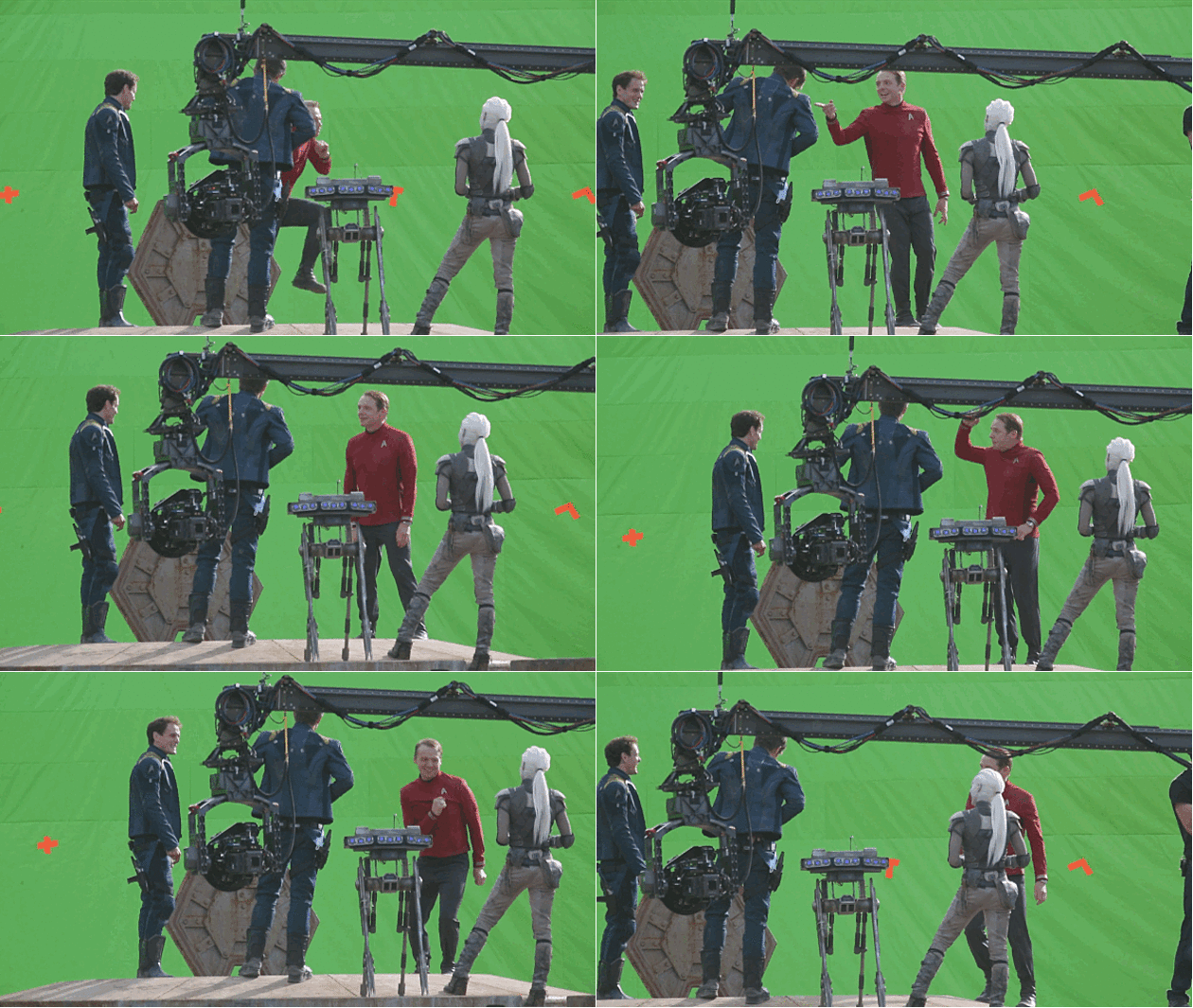
In the first ever look at Star Trek Beyond, we see a new alien with Chris Pine and Simon Pegg behind-the-scenes of the upcoming Star Trek Into Darkness sequel.
Director Justin Lin has released an exclusive, first look at Star Trek Beyond, where we see an alien working alongside actor Chris Pine, Simon Pegg and Anton Yelchin. Watch the video via ScreenCrush below:
Update: The video has been temporarily removed at the request of the studio. Be sure to check back as we’ll update this post when the video is available again.
For now, watch a GIF from the video with Simon Pegg entertaining Chris Pine and Sofia Boutella. We’ve also included some images from the Star Trek Beyond behind-the-scenes video, which show a few shots from the film via ScreenCrush. Looks like Chris is getting a little pat on the back from Sofia.

star trek beyond bts 1
star trek beyond bts 2
star trek beyond bts 2a
star trek beyond bts 3
star trek beyond bts 4
star trek beyond bts 5
star trek beyond bts 6
star trek beyond bts 8
star trek beyond bts 9
star trek beyond bts 9a
star trek beyond bts 9b
star trek beyond bts 9c
Original article: While the video is short, it’s exciting to see the cast and crew working on Star Trek Beyond, which got its title back in June. Simon Pegg has promised that the film will take the crew of the Starship Enterprise much farther than we’ve seen in the previous two films.
In the video (and images) we see some new uniforms on the trio which look very combat ready, as well as our first look at Sofia Boutella’s character. Boutella is currently playing an unnamed character, but has been described as having a “leading role” in Star Trek Beyond.
While we’re unsure who she’ll be playing specifically, she doesn’t seem to have any characteristics that would lead us to believe she’s an alien race we’ve seen in the two previous films. Although, Pegg has said there will be loads of new aliens in this film, which should be interesting considering he ended up writing the third film’s script.
The video doesn’t give us much else to go on, but it feels good to have at least video evidence that filming is underway with Chris Pine and Simon Pegg on set. We hope more footage will come out, now that J.J. Abrams doesn’t have the film locked in his secret box.
Star Trek Beyond’s new director, Justin Lin, has been more open about discussing his previous projects, and we hope to see loads of promotion for the third Star Trek film which will see the main cast return, along with some great newcomers.
Paramount has set Star Trek Beyond’s release date for July 8, 2016.

jueves, 20 de agosto de 2015

Los viajes interestelares como en 'Star Trek' serán posibles en los próximos años

Viajar por diferentes galaxias a velocidades superiores a las de luz a bordo de una nave espacial como el Enterprise de la popular serie de televisión y saga cinematográfica 'Star Trek' ('Viaje a las estrellas'), podría ser una realidad en las próximas décadas.
Según el astrofísico australiano Geraint Lewis, de la Universidad de Sídney, en una entrevista con ABC News reveló que el desplazamiento por curvatura, trasladarse más rápido que la velocidad de la luz y que fue popularizado en 'Star Trek', en teoría es posible.
El astrofísico afirma que este futurista concepto era parte de la teoría de la relatividad de Einstein, que describe cómo doblar y deformar el espacio-tiempo de tal manera que podamos viajar a cualquier velocidad en el universo.
Pero para que los viajes interestelares sean una realidad hay que construir un motor de curvatura, como el del Enterprise. "Tenemos indicios de que los materiales que necesitamos existen en el universo, pero no sabemos si podremos conseguirlos y construir este motor", agregó Lewis. Sin embargo, señaló que hasta el momento la teoría de Einstein "ha sido estudiada superficialmente" y que "en los próximos 100 o 1.000 años se revelará mucho más sobre el universo y entonces este viaje hiperveloz será posible".

Este gadget inspirado en ‘Star Trek’ cocina en menos de 1 minuto

Una empresa israelí ha empezado a comercializar un aparato que es capaz de cocinar de manera instantánea cualquier tipo de plato. Genie, que así se llama el invento, puede hacer menús personalizados para personas con intolerancias e incluso platos bajos en calorías para todos aquellos que estén haciendo dieta. 
El aparato, que está inspirado en el Replicator de Star Trek, cuesta aproximadamente 500 euros y acaba de ser lanzado en los mercados israelí y australiano. Genie funciona a través de una app de móvil desde la que se configura y se hace funcionar.
Comida encapsulada.
 
  Genie es capaz de preparar infinidad de platos (Genie | White innovation).

Genie elabora sus platos a partir de una cápsula, cuyo tamaño es de una taza aproximadamente, que contiene los ingredientes del menú deshidratados por frío, lo que garantiza que sus propiedades, su forma y su aroma se mantenga durante años.
Cuando se introduce dicha cápsula en el aparato, la maquina reconoce el menú y le añade las cantidades de líquido necesarias para que el plato quede en su punto. Este proceso le lleva al aparato aproximadamente 30 segundos.
Los alimentos que se encuentran en el interior de la capsula no llevan ningún tipo de conservante. Además, el recipiente que los contiene es biodegradable.
Evitar el derroche de alimentos
Como ha explicado el desarrollador de Genie, Doron Marco, a Efe, el precio de las cápsulas es similar a lo que costarían los alimentos en su estado normal. Uno de los objetivos de esta tecnología es dar lugar a una nueva forma de alimentación más saludable, que evite el derroche de comida ya que cada menú puede guardarse todo el tiempo que uno quiera sin riesgo a que caduque.

 Este tipo de alimentación “revolucionará la industria”, según ha expresado su creador. Su uso no está pensado solo en entornos domésticos. Para su creador, Genie es un aparato que podría ser de mucha utilidad en hospitales o colegios, donde cada persona requiere menús muy diferentes.
Los desarrolladores del aparato se encuentran en negociaciones para poder comercializarlo en Europa y en Estados Unidos, donde ya han conseguido acuerdos con grandes empresas estadounidenses del sector de la restauración.

miércoles, 19 de agosto de 2015

Francia produce chips que devuelven la visión a ciegos

El invento de la sociedad francesa Pixium Vision funciona por un doble implante: una parte del chip se instala en la superficie del globo ocular mientras que la segunda se coloca en el nervio óptico. Volver a ver ahora es posible.


La evidencia lo confirma: cinco pacientes ciegos por enfermedades degenerativas han recuperado parcialmente la visión tras el implante de un chip que emula la función de la retina. El logro se debe a la sociedad francesa Pixium Vision, la cual ha llevado a cabo con éxito el implante, el cual se compone de una pequeña cámara instalada en unos anteojos que captura señales visuales y de un chip que, dividido en dos partes, convierte esas imágenes en señales eléctricas que estimulan las neuronas y crean imágenes en el cerebro.
Noticia relacionada: Proyectan por primera vez película para ciegos en Corrientes
Una parte del chip se instala en la superficie del globo ocular mientras que la segunda, formada por una cincuentena de electrodos, se coloca en el nervio óptico. La primera paciente en someterse a esta revolucionaria operación en Francia ha sido una señora de 58 años, identificada como Barbara. La mujer perdió la visión hace dos décadas y ahora, siete meses después de la intervención, ya puede reconocer objetos, formas, luces y contornos.

Buendiario-implante-francia-cura-ciegos-pixium-3
El detalle del novedoso implante

“Es algo excepcional. Después de que me implantasen el dispositivo vi aparecer un flash y sentí una gran emoción, fue como un milagro”, indicó Barbara sobre el implante, que por el momento está en fase experimental y que solo se puede utilizar en personas aquejadas de retinosis pigmentaria, que es la causa más frecuente de degeneración hereditaria de la retina y que suele darse a partir de los 60 años.


El dispositivo no es apto para aquellos que han nacido ciegos puesto que para funcionar se sirve de la memoria visual para recrear imágenes a partir de los flashes que recibe el cerebro, pero aún así es un gran avance contra varios modos de ceguera. Uno de los fundadores de Pixium Vision, Bernard Gilly, explicó que esta tecnología podría adaptarse en el futuro para tratar formas más comunes de ceguera progresiva.
Noticia relacionada: Nuevos zapatos inteligentes llevan a los ciegos a destino
“Estamos trabajando en una nueva generación de dispositivos. La idea es llegar a alcanzar una visión lo más normal posible que le permita al paciente poder salir a la calle sin problemas, reconocer personas, hacer las compras o leer”, subrayó Gilly. Si los ensayos clínicos siguen siendo exitosos, el prototipo podrá empezar a comercializarse a partir del año que viene. Una gran noticia para que muchas personas puedan volver a ver.
Buendiario-implante-francia-cura-ciegos-pixium-2

Gene Roddenberry


Although Gene Roddenberry passed away October 24, 1991, his legacy remains as Star Trek continues to flourish and grow, as there has been 10 movies, and 7 television series, all of which maintained his vision of the future.
Gene Roddenberry, often affectionately referred to as the “Great Bird of the Galaxy,” led a life as colorful and exciting as almost any high-adventure fiction. He was born in El Paso, Texas, on August 19, 1921, and nearly escaped death as a toddler, when a house fire almost took Gene’s life, as well as his siblings, Bob, Doris, and their mother, but a milkman came along and woke them in time to avoid any injuries.
Gene spent his boyhood in Los Angeles, where he later studied three years of policemanship and then transferred his academic interest to aeronautical engineering and qualified for a pilot's license. He volunteered for the U.S. Army Air Corps in the fall of 1941 and was ordered into training as a flying cadet when the United States entered World War II. As a Second Lieutenant, Roddenberry was sent to the South Pacific where he entered combat at Guadalcanal, flying B-17 bombers out of the newly captured Japanese airstrip, which became Henderson Field. He flew missions against enemy strongholds at Bougainville and participated in the Munda invasion. He was decorated with the Distinguished flying Cross and the Air Medal.
It was while in the South Pacific, that Mr. Roddenberry began to write. He sold stories to flying magazines, and later poetry to publications, including The New York Times. He even wrote a song lyric "I Wanna Go Home", which became a popular song during the war.
At war's end, he joined Pan American World Airways. It was on a flight from Calcutta that his plane lost two engines and caught fire in flight, crashing at night in the Syrian desert. As the senior surviving officer, Roddenberry sent two Englishmen swimming across the Euphrates River in quest of the source of a light he had observed just prior to the crash impact. The Englishmen reached a Syrian military outpost, which sent a small plane to investigate. Roddenberry returned with the small plane to the outpost, where he broadcast a message that was relayed to Pan Am, which sent a stretcher plane to the rescue. Roddenberry later received a Civil Aeronautics commendation for his efforts during and after the crash.
Roddenberry continued flying until he saw television for the first time. Correctly estimating television's future, he realized that the new medium would need writers and decided that Hollywood's film studios would soon dominate the new industry. He acted immediately, left his flying career behind and went to Hollywood, only to find the television industry still in its infancy, with few openings for inexperienced writers. At a friend's suggestion, he joined the Los Angeles Police Department, following in his father's footsteps and gaining experiences which would be valuable to a writer.
It wasn't until 1966 when Roddenberry created and produced Star Trek, that he found his voice in Hollywood. The first of the two pilots were pronounced "too cerebral" by the network and rejected. Once on the air, however, Star Trek developed a loyal following as viewers grew to love the Starship Enterprise and its crew, which included the heroic Captain Kirk and the logical Vulcan, Mr. Spock.
“Space...the final frontier.
These are the voyages of the Starship Enterprise,
its five-year mission

....to explore strange new worlds
...to seek out new life and new civilizations
...to boldly go where no man has gone before.” — Gene Roddenberry (August 10, 1966)
This set the tone and mood for an entire generation of Star Trek fans.
Roddenberry unwittingly unleashed a phenomenon in which Star Trek enthusiasts became a veritable cult, numbering physicists, aerospace engineers, housewives, senators, children, teachers and intellectuals among its devotees (affectionately known as "Trekkies," and later, "Trekkers"). The show went outside television to win science fiction's coveted Hugo Award and then spawned an animated spin-off, as well as a series of feature films.
While making Star Trek, Roddenberry's reputation as a futurist began to grow. His papers and lectures earned him high professional regard as a visionary. He spoke on the subject at NASA meetings, the Smithsonian Institution, Library of Congress gatherings, and top universities.
Star Trek was so wildly popular that it has since become the first television series to have an episode preserved in the Smithsonian, where an 11-foot model of the U.S.S. Enterprise is also exhibited on the same floor as the Wright brother's original airplane and Lindbergh's "Spirit of St. Louis." In addition to the Smithsonian honors, NASA's first space shuttle was named Enterprise, in response to hundreds of thousands of letters from fans demanding that the shuttle be named after the beloved starship.
On September 4, 1986, Gene Roddenberry's fans presented him with a star on the Hollywood Walk of Fame, the first writer/producer to be so honored. Star Trek: The Next Generation, in its first year in syndication, was awarded with the 1987 Peabody Award for the "Best of the Best." The series also garnered many of the prestigious Emmy awards throughout its seven-year run. In February 1990, the March of Dimes honored Roddenberry with the Jack Benny Memorial Award of lifetime achievement.
On Thursday, October 24, 1991 Gene Roddenberry passed away and a world not so far away mourned the loss of one of television's foremost pioneers. Sadly, Gene died within 48 hours of screening Star Trek VI: The Undiscovered Country (1991), the last Trek that revolved around his original characters. At the time of his passing, Gene was survived by his wife Majel Barrett ("Nurse Chapel" from Star Trek and "Lwaxana Troi" in Star Trek: The Next Generation) and their 17-year-old son, Gene Roddenberry, Jr., his two grown daughters from a previous marriage, as well as two grandchildren.
In addition to having served as executive consultant on Star Trek feature productions, Roddenberry added "novelist" to his writing repertoire. His novelization of "Star Trek: The Motion Picture" (Pocket Books, 1979) sold close to a million copies and was ranked number one on the national bestseller lists for many weeks.

martes, 11 de agosto de 2015


George Takei (Sulu en 'Star Trek') explica por qué no había personajes LGTB en la serie

 George Takei, ha explicado en un vídeo de Big Think el motivo por el que no hubo ningún personaje homosexual en la serie de 1966. Al parecer, la culpa recaería sobre el creador de la saga, Gene Roddenberry, quien confesó al actor el motivo que ahora él mismo ha desvelado.

Takei afirma que la causa podría ser el miedo que tenía el creador a que les censuraran y, por lo tanto, perder audiencia, que podría haber teminado con la consecuente cancelación de la serie. "Yo saqué el tema de gays y lesbianas. Roddenberry era un hombre muy moderno. Dijo que era consciente de ello", comenta el actor. A pesar de su mente abierta, el tema no se trató en la ficción por un problema que tuvieron anteriormente con un beso interracial.


Miedo a la censura

El famoso beso, protagonizado por el Capitán Kirk (William Shatner) y Uhura (Nichelle Nichols), fue víctima de la censura en algunos estados. "Ese capítulo fue a negro en el sur, literalmente. Louisiana, Alabama, Mississippi o Georgia no emitieron ese momento, lo que supuso la caída de las cifras de audiencia. Fueron los peores datos que tuvimos", afirma Takei.
Parece ser que Roddenberry no quería añadir otro tema problemático a la lista, ya que según dijo, ahora en boca de Takei, "tenemos que hilar fino. Estoy tratando con temas problemáticos de la época. El Movimiento por los derechos civiles, la Guerra de Vietnam o la Guerra Fría. Tenemos que tratarlo mientras estemos en parrilla, y si trato ese tema (LGBT) no podré tratar los demás porque dejaremos de emitir".

lunes, 10 de agosto de 2015

Stewart & Takei Wrap Star Trek Las Vegas

Four days of intergalactic fun at Star Trek Las Vegas warped to a conclusion on Sunday, but not before fans gathered one last time to see some of Trek's biggest stars on the stage, to purchase a galaxy of Trek memorabilia and products, to celebrate the life of Grace Lee Whitney and more.

Patrick Stewart was the day's headliner and he didn't disappoint. Looking fit, he introduced clips from his upcoming show Blunt Talk, including a couple that feature his son Daniel once again playing his son. He answered numerous questions from fans, including one about his support of Refuge, a British anti-domestic abuse organization. Stewart made it clear that "There's never any excuse for violence. Ever."

But the emotional highlight of his session came when a witty woman, after some funny dialogue, noted that she'd waited her entire adult life to meet Stewart and probably wouldn't ever see him again due to health issues. Stewart stepped off the stage and embraced her in a hug. Returning to the stage, he said, "There are always unexpected moments at these events. It's why I still love doing them."

George Takei received a huge ovation upon taking the stage. He talked in detail about his upcoming play, Allegiance. On the passing of Leonard Nimoy, he said, "We lost our conscience. He is a real loss in the Star Trek family. He was not just an actor. He was an extraordinarily decent human being."

Deep Space Nine stars Chase Masterson, Casey Biggs, Marc Alaimo, Andy Robinson and Alexander Siddig gathered together to reminisce about their days aboard the space station and to talk about their current projects.

"People are far deeper than they look on the outside," Chase Mastetson said. "That's what the character of Leeta was about." Robinson said, "If would have been nice if Garak had a squeeze, but no one could replace dear Julian." Siddig spoke of Game of Thrones, saying, "I certainly don't know what's going on when I read a script, let alone watch it." And we loved this comment: "I'm just happy to be incredibly sexy," Alaimo cracked.
Former DS9 and Voyager writer Bryan Fuller talked about his days writing for Trek. As a fan, he said, it was a dream come true. "It was like going to college," Fuller said of learning from Brannon Braga.

Several fans wanted to hear about his current show, Hannibal, both the making of it and its possible future, as NBC did not renew the show for another season. He's still hoping to resurrect it, either next season or sometime in the future.
The folks at Disruptor Beam previewed Star Trek Timelines, and fans reacted enthusiastically. And they brought out a special guest... John de Lancie, who will provide the sonorous voice of Q.

As the session ended, de Lancie said, "I want to do work, projects I'm proud of, and I think we are in good hands."
Jeffrey Combs and Vaughn Armstrong shared the stage for their panel. Both men had auditioned for Riker. "The description for the role did not fit me at all," Combs said. "Tall, handsome, a man's man."

A fan asked Combs about being typecast. When he finished his reply, Armstrong added "I'd rather be typecast than not cast at all."  Both men thanked Trek fans for their ongoing support. "Star Trek is the gift that keeps on giving," Armstrong said.

Brent Spiner, Jonathan Frakes and LeVar Burton had the crowd cracking up. Burton admitted, "In the first season, during a long take, I fell asleep in the VISOR." Spiner noted that Data was a "struggle to play. I had to keep reminding myself to be nice. Lore was so much easier." A young boy called Riker his favorite character, prompting Frakes to tease his cast mates and to both high five the boy and pretend to slip him money. And the fun quotient rose substantially when Patrick Stewart, who'd been signing autographs off to the side of the room, joined Frakes, Spiner and Burton on stage for a few moments.

Jordan Hoffman returned to host one last One Trek Mind Live panel for the weekend. The subject of debate... Star Trek's Best Ships. The winner? An oldie but a goodie... The original USS Enterprise.


Star Trek veterans Hagan Beggs, Richard Herd, William Morgan Sheppard and Saul Rubinek teamed up for an informative panel. Rubinek enjoyed working with Brent Spiner and "loved" reuniting with him on Warehouse 13. Beggs corrected an Internet inaccuracy: his TOS role as Hansen was NOT his first-ever role, far from it.

Sheppard talked about Doctor Who and working with his son -- and Trek guest -- Mark Sheppard on it. And Herd shared an anecdote about working with both Shatner and Nimoy when Nimoy arrived on the set of T.J Hooker to act in one episode and direct another.
And the day - and Star Trek Las Vegas -- concluded in swinging, funny style with a performance by the Star Trek Rat Pack, which features Vaughn Armstrong, Armin Shimerman, Max Grodenchik, Jeffrey Combs, Casey Biggs and, providing musical accompaniment, Bill Birchell.

viernes, 7 de agosto de 2015

El CERN crea un escudo futurista para las naves espaciales al estilo de 'Star Trek'

La Organización Europea para la Investigación Nuclear (CERN) está desarrollando un sistema de protección de la radiación cósmica para astronautas basado en gigantes imanes superconductores.
Los rayos cósmicos son una de las amenazas más graves que deben tener en consideración las agencias espaciales que planean una exploración de Marte, informa 'CERN Bulletin'. El espacio es un ambiente hostil lleno de radiación que puede dañarnos. Si bien esta no impide un vuelo espacial de corta duración, como las misiones a la Luna, un viaje de seres humanos más allá de la órbita lunar obliga a contar con una protección adecuada.
Así que el CERN, en el marco del proyecto Space Radiation Superconducting Shield ('escudo superconductor de radiación espacial') o simplemente SR2R, está dispuesto a crear un sistema de escudo al estilo de 'Star Trek'. Con este fin, los científicos del CERN han unido esfuerzos con otras seis organizaciones europeas y están probando el uso de imanes superconductores de diboruro de magnesio (MgB2superconductor). Estos imanes se utilizan en el Gran Colisionador de Hadrones para crear haces de partículas ultrabrillantes a bajas temperaturas. Si se usaran en el escudo de la nave espacial, crearían una especie de magnetosfera artificial alrededor de la nave, simulando un mecanismo que evita la exposición a la radiación en la Tierra y en la atmósfera superior.
El MgB2superconductor parece cumplir todos los requisitos para ser el material adecuado para este desafío. Entre sus muchas ventajas, también está su capacidad de operar a altas temperaturas (su temperatura crítica es la más elevada que se conoce), lo que permitiría a la nave tener un sistema criogénico simplificado.

martes, 4 de agosto de 2015

En Inglaterra, ya fabrican un ascensor estilo "Star Trek"


  Vivir en una casa de más de una planta puede ser un problema, sobre todo cuando los habitantes van haciéndose mayores o aparecen problemas en las articulaciones de las rodillas u otros que dificultan el esfuerzo de enfrentar una escalera.

 En algunos casos, pueden instalarse costosos elevadores de silas para escalerasque pueden ser una solución en lugar de la instalación de un ascensor común, algo que demadaría verdaderamente mucho dinero. Sin embargo, estéticamente no suele ser atractiva una escalera con este aparato.

Por eso, una compañía en Londres desarrolló un futurista ascensor de dimensiones reducidas y fácil instalación que recuerda mucho al de Star Trek, y que además no ocupa el espacio de los tradicionales porque "cierra" el espacio del piso o del techo cuando está del otro lado. Además, como puede verse en el video, cabe en un rincón.


"Podría describirse como una silla elevadora mejorada. La gente no quiere en muchos casos, una silla que arruine su bella escalera, y no necesariamente quiere un ascensor: se trata de buscar por el ascensor ideal a prueba del paso del tiempo en la propiedad", explica a Reuters John McSweeney, de la firma Terry Lifts. Además, como ningún otro, el elevador solamente está en el ambiente en que necesita ser usado.


En Inglaterra, ya fabrican un ascensor estilo "Star Trek"

 Vivir en una casa de más de una planta puede ser un problema, sobre todo cuando los habitantes van haciéndose mayores o aparecen problemas en las articulaciones de las rodillas u otros que dificultan el esfuerzo de enfrentar una escalera.

En algunos casos, pueden instalarse costosos elevadores de sillas para escalerasque pueden ser una solución en lugar de la instalación de un ascensor común, algo que demadaría verdaderamente mucho dinero. Sin embargo, estéticamente no suele ser atractiva una escalera con este aparato.
Por eso, una compañía en Londres desarrolló un futurista ascensor de dimensiones reducidas y fácil instalación que recuerda mucho al de Star Trek, y que además no ocupa el espacio de los tradicionales porque "cierra" el espacio del piso o del techo cuando está del otro lado. Además, como puede verse en el video, cabe en un rincón.
"Podría describirse como una silla elevadora mejorada. La gente no quiere en muchos casos, una silla que arruine su bella escalera, y no necesariamente quiere un ascensor: se trata de buscar por el ascensor ideal a prueba del paso del tiempo en la propiedad", explica a Reuters John McSweeney, de la firma Terry Lifts. Además, como ningún otro, el elevador solamente está en el ambiente en que necesita ser usado.


lunes, 3 de agosto de 2015

Nichelle Nichols To Go On a NASA Mission


Just three months after suffering a minor stroke, Star Trek‘s Nichelle Nichols will be flying on a mission for NASA.
Nichols shared the news during a recent “Ask Me Anything” session on Reddit. In September, she’ll fly on the SOFIA space telescope, which is a converted Boeing 747 that can reach as high as 50,000 feet above sea level — almost, but not quite officially in space. “SOFIA does not, sadly, fly into space. It’s an airborne observatory, a massive telescope mounted inside a 747 flying as high as is possible. I was on a similar flight, the first airborn observatory, back in 1977.” Nichols flew in an early space telescope mission when it was housed in a C-141. The mission analyzed the atmospheres of Mars and Saturn during an eight-hour flight.
“It’s an amazing experience, you get a totally different perspective than from earth.”
Nichols, who played Lieutenant Uhura on the original series, worked as an ambassador for NASA during the 1970s and 1980s, focusing on recruiting women and minorities for the space program. Among them: Guion Bluford (the first African-American astronaut), Sally Ride (the first female American astronaut), Judith Resnik (one of the original set of female astronauts, who perished in the Challenger explosion on January 28, 1986), and Ronald McNair (the second African-American astronaut, who also dies in the Challenger accident).
Since the mid-80s, she has served on the Board of Governors of the National Space Society, a nonprofit, educational space advocacy organization founded by Dr. Wernher von Braun.
“I do hope someone gets some great pictures.”


Trek Actors Save Galacticon After Mass Exodus

Last-minute change in management put annual Seattle convention in jeopardy


There may be a lot of eyes on Las Vegas Creation Entertainment's official Star Trek convention next weekend, but it's a smaller gathering in Seattle this weekend that is getting more attention than it would probably prefer.
Galacticon, a Battlestar Galactica-centric convention co-created by original BSG star Richard Hatch, is set to get underway. But it just won't be doing it with very many people from "Battlestar Galactica."
Instead, the heavily truncated guest list is led by two Klingons — J.G. Hertzler and Robert O'Reilly — in a series of events that have forced its executive producer to resign, creating some very unhappy fans.
Daniel Allen resigned as head of the convention earlier this week after a number of actors, including big names like Edward James Olmos and Grace Park, were cut from this weekend's convention. Allen accepted the blame for the losses, and then redirected it to problems with its host hotel.
"A lot of rumors are floating around about why a lot of our BSG cast has been canceled," Allen wrote on the convention's website. "The truth of the matter is that we have lost our room block of hotel rooms. In light of this, I made the decision to do what was in the best interests of our guests. They are rightfully so upset about this, but we didn't want to run the risk of having people come to Seattle and not have a place for them to stay."
The convention was designed to be similar to Star Wars Celebration, taking place every five years, beginning in 2003 in Los Angeles. The second convention was held in 2008 on a cruise ship to Mexico while Houston hosted the third one in 2013.
It's not immediately clear why the most recent convention didn't wait until 2018 but instead was scheduled for the Seattle Center.
Besides Hertzler and O'Reilly, the convention still promoted a guest lineup that includes "Star Trek: Deep Space Nine" guest star Bill Mumy and "Star Trek: Voyager" recurring actor Manu Intiraymi.
Hatch, the convention co-founder (who also is participating in the upcoming Star Trek fan production "Axanar"), says he's still attending.
Refund options remain a mystery for fans who purchased tickets before the guest cancellations this week.
"The new management team is absolutely committed to accommodating every reasonable request we receive," one of the new managers, Michael DeVault, posted on the convention's Facebook page. "That process is being developed. However, given that the most immediate need is getting the convention open and making this a success for the fans and the guests, this process will almost certainly not be finalized until after the convention, at which point the new management will provide via all channels the process and procedures you'll need to follow."
The convention sold tickets at $30 for the day, $90 for the weekend. VIP passes were sold out at $275 each, but convention organizers did not reveal how many of such tickets were available. The convention's rather sparse ticket policy does state that all sales are final. However, the convention did state that tickets are transferable, so customers are able to resell their passes to someone else.
One fan, Jan Jarrell, posted on the convention's Facebook page that she expects a full refund since the guests she planned to see are no longer attending.
"My questions are the same," she said. "Do I go to a con that really no longer interests me because my purchase was made on the basis of false information and risk losing a potential refund? Do I stay home and basically hand them almost $100 for absolutely nothing?
"I realize they have an event to put on, but I'm sorry, they owe it to us to clean up the mess they created before this is all water under the bridge."
DeVault responded to Jarrell and other early posters demanding refunds immediately that he is cleaning up someone else's mess.
"The new management team was not responsible for creating the track record of which you speak, and is currently doing our level best to make the best convention experience possible," DeVault wrote. "We didn't create the situation. We're just committed to fixing

domingo, 2 de agosto de 2015

STAR TREK
XXIV CENTURY WOMEN